English
 Español
 tiếng việt
 русский
High reactivity due to the electron-deficient allylic chloride group, enabling efficient nucleophilic substitution and addition reactions.
Low boiling point (45–46 °C) facilitates easy separation and recovery in continuous process applications.
Excellent solubility in common organic solvents including chloroform, ether, and benzene—ideal for homogeneous reaction systems.
Stable under anhydrous, cool, and dark storage conditions when protected from light and moisture.
Key building block for synthesizing high-value intermediates such as epichlorohydrin, allyl alcohol, and pharmaceutical precursors.
Production of epichlorohydrin—a critical monomer for epoxy resins and water treatment polymers.
Synthesis of allyl amines and quaternary ammonium compounds used in agrochemicals and surfactants.
Preparation of allyl esters and ethers for fragrance ingredients and polymer crosslinkers.
Intermediate in pharmaceutical manufacturing, including antithyroid agents and cardiovascular drug derivatives.
Chemical modification of resins, gums, and cellulose to enhance adhesion, flexibility, and hydrophobicity.
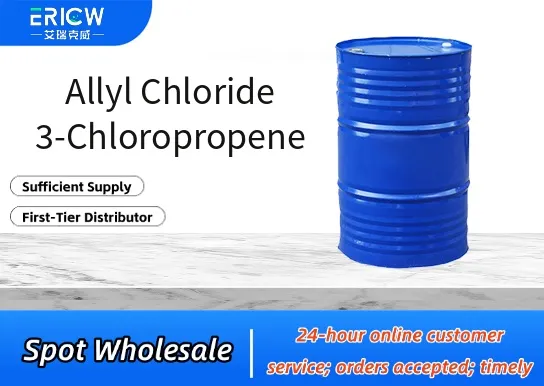
| Chemical Name | Allyl chloride (3-Chloropropene) |
| Molecular Formula | C₃H₅Cl |
| Molecular Weight | 76.52 g/mol |
| Appearance | Colorless to pale yellow clear liquid |
| Odor | Pungent, chloroform-like |
| Boiling Point | 45–46 °C at 760 mmHg |
| Density (20 °C) | 0.938–0.942 g/cm³ |
| Purity (GC) | ≥ 99.0% |
Contact With Us:
E-mail: wangxingqiang@ericwchem.com
Have a Questions? Call Us:
Add:
Building A1, Jiete Industrial Park, Huangpu District, Guangzhou City, Guangdong Province, China