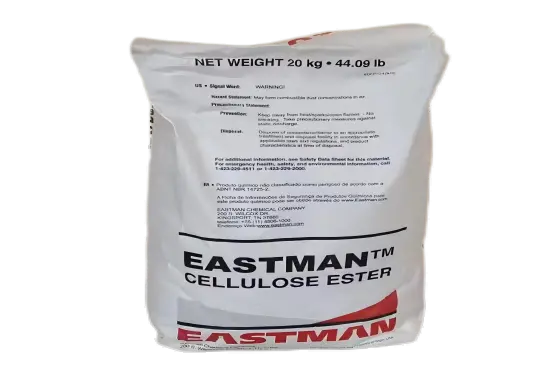
Features Of Eastman Cellulose Acetate Butyrate CAB
Enhanced Pigment Orientation – Optimizes metallic flake alignment for premium visual effects and high-gloss finishes.
Rapid Curing & Drying – Accelerates solvent release and reduces production downtime.
Superior Weather Resistance – UV-stable formulation prevents yellowing, ensuring outdoor durability.
Broad Compatibility – Works seamlessly with acrylics, polyurethanes, and other resin systems.
Eco-Friendly Performance – Supports high-solid/low-VOC formulations with food-safe compliance.
Typical Applications Of Eastman Cellulose Acetate Butyrate CAB
Automotive Coatings – OEM topcoats, refinish paints, and metallic basecoats.
Wood & Furniture Finishes – Non-yellowing varnishes for premium furniture and musical instruments.
Plastic & Electronic Coatings – Wear-resistant finishes for housings and decorative components.
Industrial & Packaging – FDA-compliant inks for food packaging and heavy-duty equipment protection.
Specifications Of Eastman Cellulose Acetate Butyrate CAB
| Model | Butyryl Content | Acetyl Content | Viscosity (sec/Poise) | Melting Point (°C) | Bio-based Content |
| CAB-381-0.5 | 37% | 13% | 0.5 sec / 1.9 Poise | 155–165 | ~40% |
| CAB-381-20 | 37% | 13.50% | 20 sec / 76 Poise | 195–205 | / |
| CAB-551-0.01 | 53% | 2% | 0.01 sec / 0.038 Poise | 127–142 | ~60% |
| CAB-531-1 | 50% | 3% | 1.9 sec / 7.2 Poise | 135–150 | / |
| CAB-553-0.4 | 46% | 2% | 0.3 sec / 1.14 Poise | 150–160 | ~60% |
| CAB-171-15 | 17% | 29.50% | / | / | 60% |
| CAB-321-0.1 | 32.50% | / | 0.38 Poise | / | ~42% |
| CAB-381-0.1 | 32.50% | / | 0.38 Poise | / | ~42% |
| CAB-500-5 | 51% | / | 19 Poise (ASTM A) | 165–175 | ~60% |
| CAB-381-2 | 38% | 13.50% | 2 sec / 7.6 Poise | 171–184 | / |
Eastman Cellulose Acetate Butyrate CAB – Frequently Asked Questions (FAQ)
Q1: What are the primary advantages of CAB over other cellulose esters like cellulose acetate (CA) or cellulose acetate propionate (CAP)?
A: CAB offers a unique balance of solubility, toughness, and moisture resistance due to its butyryl content. It dissolves in a broader range of common organic solvents—including ketones, esters, and some alcohols—without requiring chlorinated solvents. Its lower moisture sensitivity and improved impact resistance compared to CA make it especially suitable for demanding coatings and film applications.
Q2: Is CAB compatible with common polymer resins used in industrial coatings and inks?
A: Yes, CAB demonstrates good compatibility with many thermoplastic resins such as acrylics, vinyls, polyurethanes, and certain epoxies. It is frequently used as a rheology modifier, film-former, or adhesion promoter in multi-component systems—enhancing gloss, substrate wetting, and mechanical integrity without phase separation under standard formulation conditions.
Q3: How does CAB perform in outdoor applications exposed to UV light and weathering?
A: CAB exhibits inherently good UV stability and weather resistance due to its saturated aliphatic backbone and absence of chromophores commonly found in aromatic polymers. When properly formulated—with appropriate UV absorbers or HALS stabilizers—it maintains clarity, flexibility, and adhesion in exterior coatings, automotive trim, and protective films over extended service life.
Q4: Can CAB be processed using standard thermoplastic methods such as extrusion or injection molding?
A: Yes, CAB is thermoplastic and can be melt-processed using conventional equipment. It typically requires moderate processing temperatures and benefits from controlled moisture removal prior to processing. Its melt viscosity and thermal stability support stable extrusion of films and sheets, as well as injection molding of small, precision parts—though residence time should be minimized to preserve molecular integrity.
 English
 Español
 tiếng việt
 русский