English
 Español
 tiếng việt
 русский
In polymer processing, coatings, and plastic modification, wax powders are important surface-modifying additives. Their performance can influence slip, abrasion resistance, gloss, anti-blocking behavior, processing lubrication, and surface feel.
Manufacturers commonly face three challenges.
Different applications require different particle-size distributions, melting ranges, hardness levels, polarity, and dispersion characteristics. Small and medium-sized manufacturers may lack a systematic selection process, leading to repeated trials and higher material-development costs.
Uncontrolled substitute materials or unclear supply channels may have inconsistent particle size, impurities, melting behavior, or surface treatment. These variations can cause coating haze, poor dispersion, surface migration, or deposits on plastic products.
Traditional channels may require large-volume purchasing. R&D teams that need multiple grades in small quantities can face long procurement cycles, which slows formulation development and product validation.
These challenges have increased demand for suppliers that combine international brand sourcing, flexible order quantities, and application-oriented technical support.
Guangzhou Eric Wei Chemical Co., Ltd. (ERICW) supplies selected wax powders and related additives from brands such as Clariant, Honeywell, and Croda. The company combines branded product sourcing, supply-chain coordination, and technical assistance from material selection through application testing.
Clariant Ceridust® products are micronized wax powders designed for controlled particle-size distribution and surface-performance applications.
Ceridust® 3620 is a polyethylene-wax-based product used in selected wood-coating, industrial-coating, ink, and plastic applications. It may be considered where abrasion resistance, slip, anti-blocking, and surface feel are important.
Ceridust® 5551 is a polypropylene-wax-based product for applications requiring higher hardness, heat resistance, and surface durability. It may be evaluated in powder coatings, baked coatings, and other high-temperature systems.
Ceridust® PE520 is a modified polyethylene wax powder that may be considered for applications requiring fine surface appearance, controlled dispersion, and consistent tactile performance.
The final suitability of each grade depends on particle-size distribution, resin compatibility, dosage, processing temperature, and the customer’s performance targets. Current technical data should be confirmed with the product supplier.
Honeywell A-C® waxes are selected according to molecular structure, polarity, melting behavior, and compatibility with the surrounding formulation.
A-C® 316A is an oxidized polyethylene wax used in selected polar resin and waterborne systems. Its modified chemical structure may support dispersion, wetting, anti-settling behavior, and scratch resistance.
It may be evaluated in acrylic, polyester, waterborne coating, ink, and pigment-containing formulations.
A-C® 629A is a polyethylene-based wax used in selected plastic-processing, masterbatch, and coating systems. It may provide internal lubrication, improve melt flow, and support filler dispersion.
The actual effect depends on polymer type, processing temperature, filler content, shear conditions, and dosage.
Croda supplies selected amide additives that can complement wax powders in plastic-film and polymer-processing applications.
Erucamide is commonly evaluated as a slip and anti-blocking additive for polyethylene and polypropylene films. It migrates gradually toward the film surface and can reduce the coefficient of friction.
The appropriate dosage depends on film structure, storage time, processing conditions, and required slip performance.
Oleamide generally migrates more quickly than erucamide and may be considered for applications requiring faster slip development or short-cycle processing.
Compatibility and migration behavior should be validated in the target polymer and production process.
As VOC regulations become stricter, coatings manufacturers are increasingly adopting high-solids, waterborne, and powder-coating technologies.
Micronized wax powders can be incorporated into selected powder and high-solids formulations without adding liquid solvents. They may support processing, scratch resistance, surface slip, and gloss control.
Demand has expanded beyond basic slip. High-end applications may require a controlled combination of:
Gloss level
Surface feel
Scratch resistance
Anti-fingerprint performance
Anti-blocking behavior
Chemical resistance
Transparency
Processing stability
This creates a need for suppliers that can recommend products and combinations rather than simply provide a standard material.
ERICW has established a strategic collaboration with the Hebei Waterborne Coatings Industrial Technology Research Institute. For applicable projects, this may support wax-powder compatibility testing, formulation evaluation, and performance comparison.
Different markets have different regulatory and application requirements.
European customers may prioritize REACH documentation, VOC control, and sustainability information.
Southeast Asian customers may focus on cost efficiency, delivery flexibility, and application performance.
North American customers may require market-specific compliance documents, including food-contact or other regulatory declarations where applicable.
ERICW serves customers across the Pearl River Delta, Yangtze River Delta, Southeast Asia, the Middle East, Africa, North America, and Europe. Product compliance, availability, and documentation must be confirmed for each destination and grade.
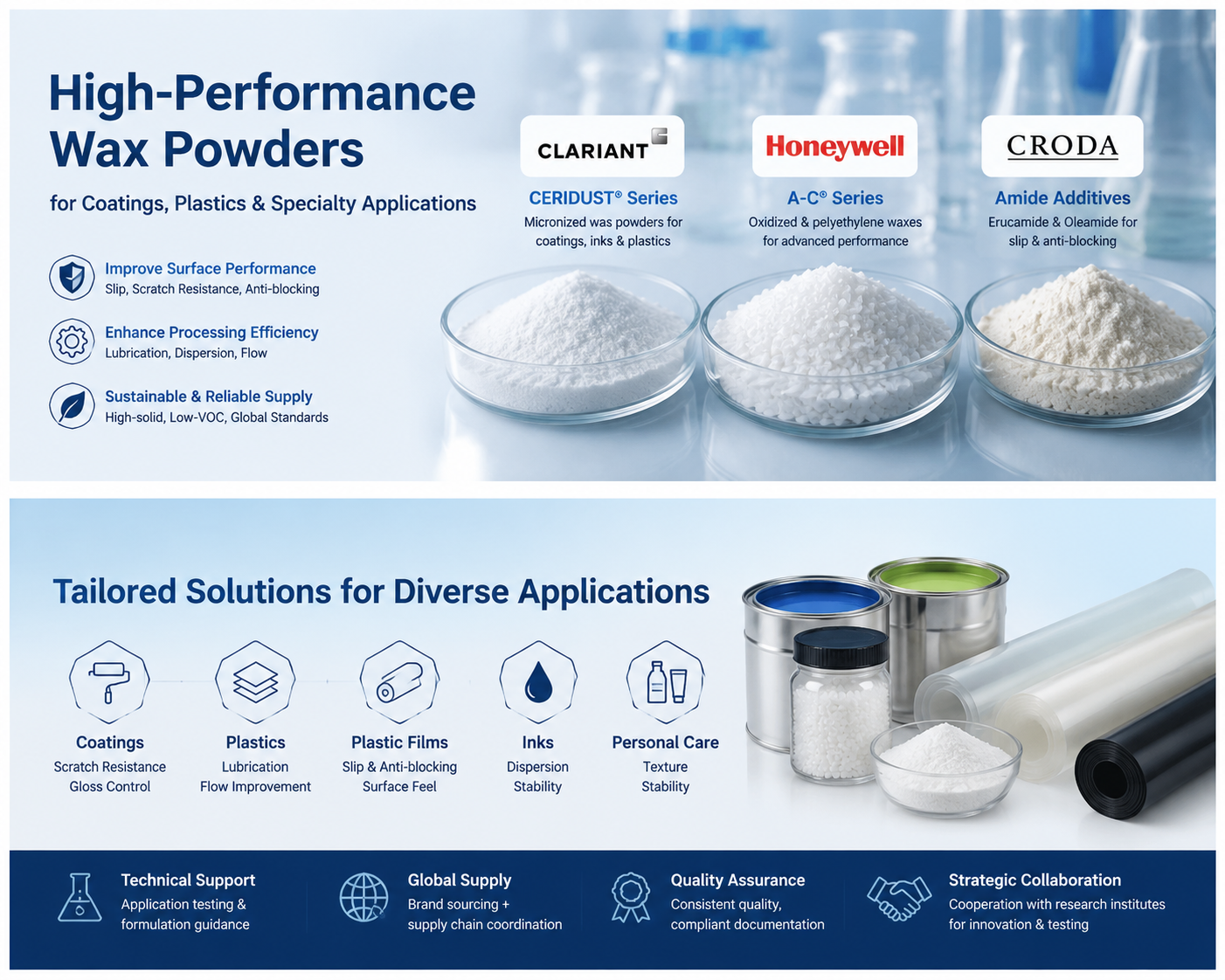
ERICW supplies selected wax powders and related additives from Clariant, Honeywell, Croda, and other chemical brands, subject to product availability and applicable supply arrangements.
The company states that its product portfolio covers more than 50 product series and over 30,000 SKUs. Selected products may be available for small-batch or trial-order purchasing.
This model allows customers to compare products, conduct testing, and consolidate orders through one sourcing channel.
ERICW uses an AI-assisted recommendation process designed to match products with customer inputs such as:
Application scenario
Resin or polymer type
Processing method
Required slip or abrasion resistance
Gloss and transparency targets
Melting range
Dispersion and compatibility requirements
ERICW reports that its recommendation process achieves an accuracy rate above 85% in applicable use cases. Recommendations should be verified through laboratory testing before production adoption.
For applicable products, customers may request technical data sheets, safety data sheets, certificates of analysis, batch-related information, and relevant compliance documents.
ERICW states that it completed an on-site assessment by CTI through Made-in-China.com in October 2025. The company also works with cooperative manufacturing facilities with a reported annual capacity of 3,000 metric tons for selected self-brand or customized products.
Formulation teams should record the performance of different grades in their own systems, including:
Addition level
Dispersion method and time
Processing temperature
Surface gloss
Slip and friction
Abrasion and scratch resistance
Surface migration
Storage stability
Impact on mechanical properties
This information can create an internal selection standard and reduce repeated testing.
Buyers should prioritize suppliers that can provide:
Current TDS and SDS
Certificates of analysis
Product origin and batch information
Sample or small-batch support
Application testing
Compatibility guidance
Logistics and delivery coordination
Companies should continue tracking:
Waterborne wax emulsions
Functionalized and grafted waxes
Micronized and fine-particle waxes
Bio-based waxes
Low-dust processing additives
Wax systems designed for high-solids and powder coatings
Industry associations and technical institutions can help develop clearer test methods and application guidelines for wax powders. More consistent data would help smaller manufacturers compare materials and reduce selection risk.
Wax-powder supply is no longer limited to product delivery. It increasingly involves formulation support, application testing, regulatory documentation, flexible quantities, and supply-chain coordination.
Suppliers with international brand resources, technical selection capabilities, and flexible procurement options can help manufacturers improve formulation efficiency and reduce development risk.
Guangzhou Eric Wei Chemical Co., Ltd. provides selected wax powders and related additives through the ERICW supply-chain service platform.
Company: Guangzhou Eric Wei Chemical Co., Ltd.
Brand: ERICW
Website: https://www.ericwchem.com
Business Inquiries: wangxingqiang@ericwchem.com
This article is for general informational purposes only. Product specifications, technical performance, availability, authorization status, pricing, delivery schedules, and regulatory compliance must be confirmed for each product and order. Brand names and trademarks belong to their respective owners. Customers should conduct laboratory and production-scale validation before selecting materials.


Vice Chairman of the Coatings and Adhesives Association
Senior New Materials R&D Engineer
Bachelor of Engineering
General Manager
Professional Experience: With 10 years of experience in the fine chemical industry, the team has served over 10,000 clients. Committed to providing one-stop fine chemical services for global clients and helping them optimize the selection of chemical materials.