English
 Español
 tiếng việt
 русский
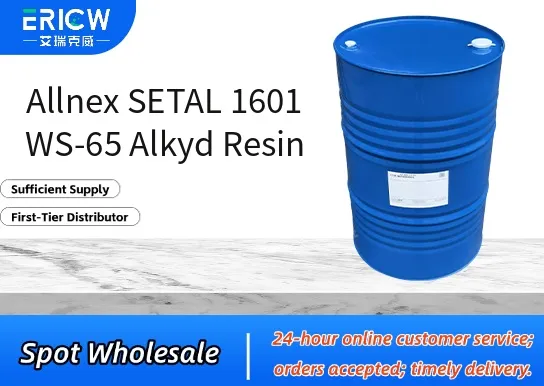
Water-reducible alkyd resin enabling low-VOC, high-performance coatings without co-solvents.
Excellent gloss retention and film hardness development in ambient-cure applications.
Good compatibility with acrylic emulsions, cellulose derivatives, and associative thickeners.
Superior hydrolytic stability and shelf life in neutral to slightly alkaline aqueous dispersions.
Enables formulation of durable, flexible films with balanced scrub resistance and block resistance.
Interior architectural wall paints for premium-quality, low-odor finishes.
Wood coatings including primers and topcoats for furniture and cabinetry.
Metal primers and maintenance coatings for industrial and agricultural equipment.
Low-VOC decorative coatings for DIY and professional contractor markets.
Hybrid waterborne systems combining alkyd durability with acrylic weatherability.
| Chemical Type | Water-reducible short-oil alkyd resin (soybean oil modified) |
| Product Form | Aqueous dispersion (non-ionic, self-emulsifying) |
| Appearance | Opaque white to off-white liquid |
| pH (10% aqueous solution) | 7.5–8.5 |
| Solids Content (wt %) | 64–66 |
| Viscosity (Brookfield RVT, #3 spindle, 20 rpm, 25°C) | 1,500–3,500 mPa·s |
| Minimum Film Formation Temperature (MFFT) | ≈ 15°C |
| Primary Applications | Waterborne architectural and industrial protective coatings |
Q1: What is the primary application field for SETAL 1601 WS-65?
A: SETAL 1601 WS-65 is a water-reducible alkyd resin specifically designed for high-performance, low-VOC architectural and industrial maintenance coatings—especially where good gloss retention, substrate wetting, and compatibility with acrylic dispersions are required.
Q2: Is SETAL 1601 WS-65 compatible with common co-binders like acrylic or vinyl acetate dispersions?
A: Yes, it exhibits excellent compatibility with a broad range of synthetic polymer dispersions—including acrylics and VAE emulsions—enabling hybrid systems that balance alkyd performance with enhanced drying speed and water resistance.
Q3: How should SETAL 1601 WS-65 be neutralized and incorporated into aqueous formulations?
A: It is typically neutralized with low-molecular-weight amines such as dimethylethanolamine (DMEA) or triethylamine (TEA) to achieve stable dispersion in water. Pre-neutralization prior to addition to the aqueous phase is recommended, followed by gentle agitation to avoid foam generation.
Q4: Does SETAL 1601 WS-65 contribute to film hardness development and what is its typical role in the binder system?
A: As a medium-oil, semi-crystalline alkyd resin, it supports balanced film formation—providing early hardness build and improved scrub resistance while maintaining flexibility and adhesion across diverse substrates.
Contact With Us:
E-mail: wangxingqiang@ericwchem.com
Have a Questions? Call Us:
Add:
Building A1, Jiete Industrial Park, Huangpu District, Guangzhou City, Guangdong Province, China