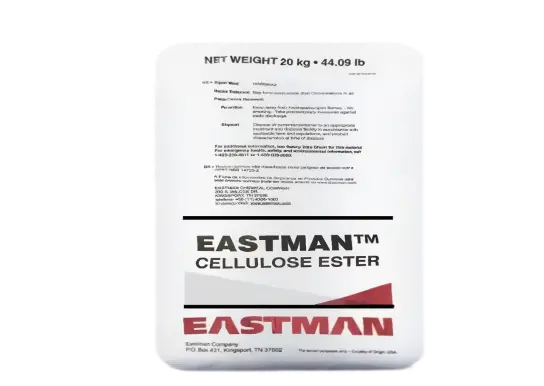
Features Of Eastman Cellulose Tenite
Versatile Viscosity Range: Suitable for both low and high-solids formulations with excellent flow control.
Superior Weather Resistance: Provides UV stability and long-term color retention.
Enhanced Processability: Features fast-drying properties and easy dispersion in various systems.
Material Compatibility: Works effectively with acrylics, polyurethanes, and multiple substrates.
Eco-Friendly Performance: Low VOC emissions with FDA-compliant options available.
Typical Applications Of Eastman Cellulose Tenite
Printing Inks: For packaging, publications, and specialty metallic inks.
Protective Coatings: Industrial varnishes for metal, plastic, and wood substrates.
Food Packaging: Compliant barrier coatings for food-contact materials.
Decorative Finishes: High-performance coatings for consumer electronics and automotive applications.
Specifications Of Eastman Cellulose Tenite
| Model | Plasticizer Content | Bio-based Content | Light Transmittance (Thickness) | Impact Strength (23℃) |
| 285A2R30018 | 10% | ≥60% | 90% (1.52mm) | 240 J/m |
| 264E4861310 | 10% | ≥60% | 90% (1.52mm) | 240 J/m |
| 264E2R30008 | 8% | ≥60% | 90% (1.52mm) | 198 J/m |
| 264A3720013 | 13% | ≥60% | 90% (1.52mm) | 280 J/m |
| 105E4T62328 | 28% | ≥60% | 92% (1mm) | 187 J/m |
| 105E3V36327 | 27% | ≥60% | 92% (1mm) | 187 J/m |
Eastman Cellulose Tenite – Frequently Asked Questions (FAQ)
Q1: What is Eastman Cellulose Tenite primarily used for in industrial applications?
A: Eastman Cellulose Tenite is a family of thermoplastic cellulose esters widely employed as film-forming agents, binders, and rheology modifiers—particularly in coatings, inks, adhesives, and specialty plastics where clarity, toughness, and compatibility with polar solvents are valued.
Q2: How does Eastman Cellulose Tenite differ from other cellulose derivatives like ethyl cellulose or nitrocellulose?
A: Unlike ethyl cellulose—which offers higher thermal stability but lower solubility in common organic solvents—or nitrocellulose—which is highly flammable and regulated—Cellulose Tenite provides a balanced combination of good solvent versatility (e.g., acetone, MEK, ethyl acetate), moderate thermal processability, and inherently lower volatility and flammability risk.
Q3: Is Eastman Cellulose Tenite suitable for food-contact or pharmaceutical applications?
A: Certain grades of Cellulose Tenite may be considered for indirect food-contact applications where regulatory compliance is verified by the end-user formulator; however, it is not generally approved for direct food contact or pharmaceutical use without additional qualification and regulatory review by the responsible party.
Q4: What solvents are recommended for dissolving Eastman Cellulose Tenite?
A: It exhibits good solubility in ketones (e.g., acetone, methyl ethyl ketone), esters (e.g., ethyl acetate), and certain chlorinated solvents; solubility in alcohols or water is very limited, and formulation compatibility should always be confirmed empirically under intended processing conditions.
 English
 Español
 tiếng việt
 русский