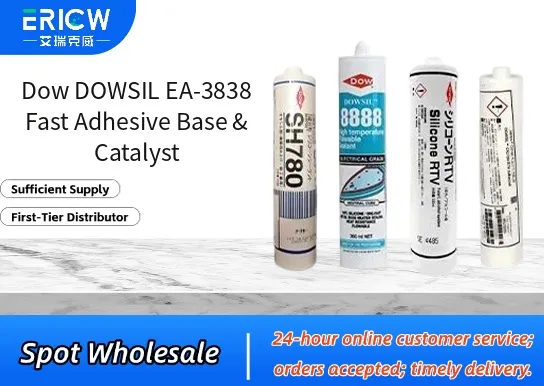
High-performance, one-component silicone adhesive with excellent adhesion to glass, aluminum, and painted surfaces.
Room-temperature vulcanizing (RTV) formulation enabling fast cure without external catalysts or heat.
Outstanding resistance to UV radiation, thermal cycling, and weathering for long-term outdoor durability.
Low modulus elasticity provides superior stress relief in bonded assemblies subject to vibration or thermal expansion.
Non-corrosive to sensitive substrates including copper and electronics components.
Structural glazing in commercial façades and curtain wall systems.
Bonding of solar panel frames, junction boxes, and mounting hardware.
Sealing and bonding of LED lighting housings and optical assemblies.
Automotive exterior trim attachment and sensor housing encapsulation.
Industrial signage assembly requiring high clarity and weather resistance.
| Chemical Type | Acetoxy-cure silicone elastomer |
| Product Form | Thixotropic paste, single-component |
| Appearance | Opaque white to off-white |
| Primary Applications | Structural bonding, sealing, and gasketing |
| Key Features | RTV cure, non-corrosive, UV stable, low modulus |
| Shore A Hardness (7 days, 23°C/50% RH) | 25–30 |
| Tensile Strength (ASTM C1135) | 1.8–2.2 MPa |
| Specific Gravity (25°C) | 1.45–1.50 |
Q1: What is the primary chemistry and functional mechanism of DOWSIL 2013 Adhesive?
A: DOWSIL 2013 Adhesive is a silicone-based adhesive formulated with reactive silane functionality, enabling strong covalent bonding to substrates such as glass, metals, and ceramics. It cures at room temperature via moisture-catalyzed condensation, forming durable, flexible silicone networks with excellent adhesion retention under thermal and environmental stress.
Q2: Is DOWSIL 2013 suitable for bonding dissimilar substrates in demanding environments?
A: Yes — it is specifically engineered for reliable bonding between dissimilar materials (e.g., aluminum to glass, stainless steel to silicone rubber) and maintains performance across wide temperature ranges, humidity fluctuations, and intermittent UV exposure. Its low modulus and high elongation help accommodate differential thermal expansion without delamination.
Q3: How does surface preparation affect bond strength and reliability?
A: Proper surface cleaning and activation are critical. Surfaces should be free of oils, release agents, and weak boundary layers. For optimal results, solvent wiping (e.g., isopropyl alcohol) followed by plasma or corona treatment — especially on low-energy plastics or aged silicone — is strongly recommended to maximize interfacial adhesion and long-term durability.
Q4: Can DOWSIL 2013 be overcoated or encapsulated after curing?
A: Fully cured DOWSIL 2013 generally accepts overcoating with compatible silicone elastomers, polyurethanes, and certain acrylics. However, compatibility testing under intended service conditions is advised, as some topcoats may exhibit interfacial adhesion issues or cure inhibition depending on formulation chemistry.
Q5: What are typical handling and storage recommendations?
A: Store unopened containers in a cool, dry place below 30°C, away from direct sunlight and moisture sources. Once opened, reseal tightly and use within recommended shelf life; avoid prolonged exposure to ambient humidity during dispensing to prevent premature surface skinning or viscosity changes.
Contact With Us:
E-mail: wangxingqiang@ericwchem.com
Have a Questions? Call Us:
Add:
Building A1, Jiete Industrial Park, Huangpu District, Guangzhou City, Guangdong Province, China
 English
 Español
 tiếng việt
 русский