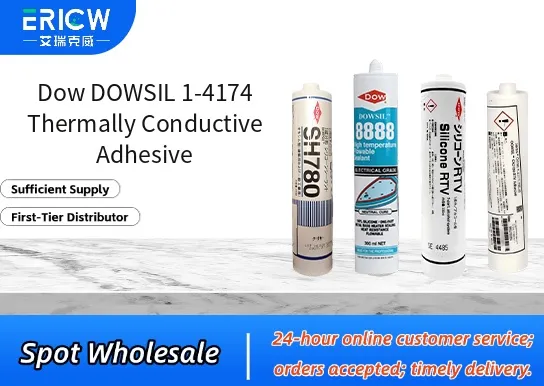
High thermal conductivity (≥1.5 W/m·K) for efficient heat dissipation in compact electronic assemblies.
Room-temperature cure with optional heat acceleration, enabling flexible manufacturing integration.
Low modulus elastomeric formulation that accommodates coefficient of thermal expansion (CTE) mismatch between substrates.
Excellent adhesion to common electronics substrates including aluminum, copper, ceramics, and FR-4 PCBs.
UL 94 V-0 rated for flame retardancy, supporting safety compliance in power electronics applications.
Thermal interface bonding of IGBT modules and power semiconductor packages to heat sinks.
Attachment of LED packages and COB (chip-on-board) arrays in high-brightness lighting systems.
Die attach and thermal management for automotive ADAS sensors and onboard chargers.
Structural thermal bonding in 5G base station RF power amplifiers and mmWave antenna modules.
| Chemical Type | Heat-curable silicone adhesive with thermally conductive filler |
| Product Form | Paste (thixotropic, dispensable via syringe or jetting) |
| Appearance | Gray, uniform paste |
| Primary Applications | Thermal interface material (TIM) for structural bonding and heat transfer |
| Key Features | Electrically insulating, low stress, UL 94 V-0 rated |
| Benefits | Reduces thermal resistance, eliminates need for secondary mechanical fasteners, supports automated assembly |
| Cure Schedule (Typical) | 24 hrs at 25°C or 60 min at 100°C |
| Storage Condition | Refrigerated at 2–8°C; stable for 12 months unopened |
Q1: What substrates does DOWSIL 1-4174 bond well to?
A: DOWSIL 1-4174 provides strong adhesion to a wide range of engineering substrates including aluminum, copper, stainless steel, nickel-plated surfaces, and common thermoplastics and thermosets used in electronics packaging—such as PPA, LCP, and epoxy mold compounds. Surface preparation (e.g., cleaning and optional plasma treatment) is recommended for optimal bond reliability.
Q2: How is thermal conductivity achieved without compromising electrical insulation?
A: The adhesive utilizes a proprietary filler system designed to form efficient thermal pathways while maintaining high dielectric strength and volume resistivity. It is formulated to be electrically insulating, making it suitable for applications where galvanic isolation between heat-generating components and heat sinks is required.
Q3: What is the typical cure profile, and can it be cured at lower temperatures?
A: DOWSIL 1-4174 is a two-part addition-cure silicone adhesive that achieves full cure at elevated temperatures (e.g., 125–150 °C for 30–60 minutes). A partial room-temperature cure occurs over several days, but accelerated low-temperature curing (e.g., 80–100 °C) is possible with extended time—though final thermal and mechanical performance is optimized under standard thermal cure conditions.
Q4: Is this adhesive compatible with automated dispensing systems?
A: Yes, DOWSIL 1-4174 is formulated for compatibility with standard industrial metering-mix-dispensing equipment. Its viscosity and pot life support precise, repeatable application in high-volume assembly environments—including jetting and needle dispensing—when handled within its recommended processing window.
Contact With Us:
E-mail: wangxingqiang@ericwchem.com
Have a Questions? Call Us:
Add:
Building A1, Jiete Industrial Park, Huangpu District, Guangzhou City, Guangdong Province, China
 English
 Español
 tiếng việt
 русский