English
 Español
 tiếng việt
 русский
Titanium dioxide (TiO₂) is a key white pigment and hiding agent used in coatings, plastics, inks, masterbatches, and other specialty chemical applications. Its performance directly affects opacity, whiteness, gloss, weather resistance, dispersion, and color stability.
Today, buyers face three common challenges:
Many brands, limited comparability
Product specifications are not always presented using fully consistent testing methods, making direct comparisons difficult.
Different applications require different grades
Architectural coatings, automotive finishes, plastics, inks, and UV-curable systems may require different particle-size distributions, surface treatments, dispersion properties, and weatherability levels.
Batch consistency and supply risk
Unclear supply channels and inconsistent quality control can create variation between batches and affect production stability.
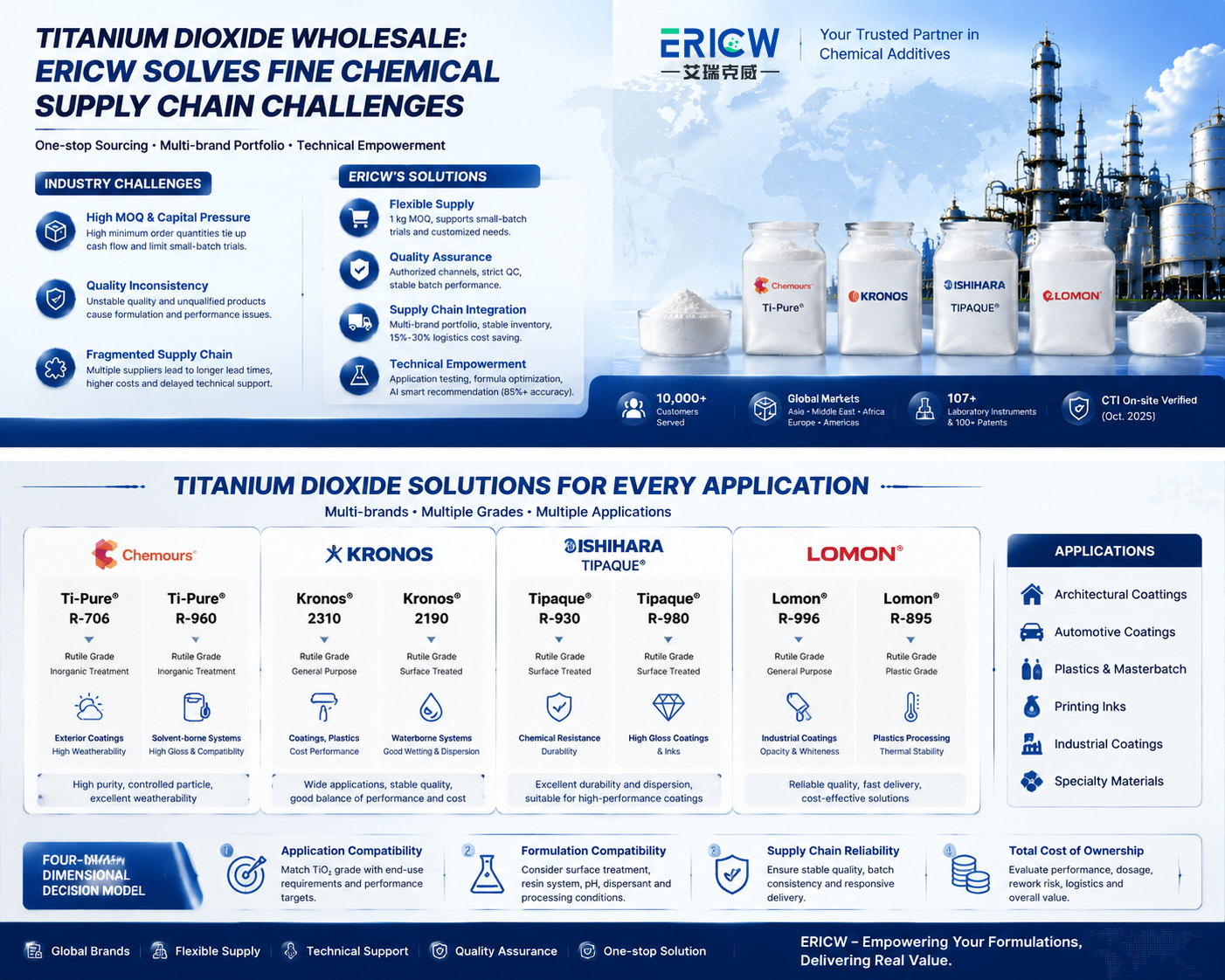
Guangzhou Eric Wei Chemical Co., Ltd. has more than 10 years of industry experience through its founding team and reports cumulative service experience with over 10,000 customers. The company supplies selected titanium dioxide products from brands such as Chemours, Kronos, Ishihara, and Lomon.
Through a strategic collaboration with the Hebei Waterborne Coatings Industrial Technology Research Institute, ERICW can coordinate application testing and technical evaluation for selected projects.
Chemours Ti-Pure® products are produced using chloride-process technology and are known for high purity and controlled particle characteristics.
Ti-Pure® R-706: A rutile-grade product with inorganic surface treatment, considered for exterior coatings and other applications requiring weather resistance.
Ti-Pure® R-960: Designed for selected solvent-borne systems where dispersion, gloss, and resin compatibility are important.
The choice between these grades depends on the coating system, resin type, surface-treatment requirements, weatherability target, and application method.
Kronos® titanium dioxide products are widely used in coatings, plastics, and other industrial formulations.
Kronos® 2310: A general-purpose rutile grade for applications where a balance between performance and cost is required.
Kronos® 2190: A grade considered for selected waterborne formulations where wetting and dispersion behavior are important.
The selection should take into account formulation pH, shear conditions, dispersant compatibility, and required stability during storage and application.
Ishihara Tipaque® products are used in a range of Asian and international coating and pigment applications.
Tipaque® R-930: Considered for coatings requiring chemical resistance and durability.
Tipaque® R-980: Used in selected high-gloss coating and ink systems where uniform particle characteristics and dispersion are important.
Performance depends on surface treatment, pigment concentration, resin polarity, and the selected dispersant package.
Lomon® is a major titanium dioxide product family from China and is used in coatings, plastics, and industrial pigment applications.
Lomon® R-996: A rutile-grade product considered for opacity, whiteness, and general industrial coating applications.
Lomon® R-895: Used in selected plastic-processing applications where thermal stability and processing behavior are important.
Local availability and supply responsiveness may make Lomon® products suitable for manufacturers that prioritize delivery flexibility and regional supply support.
Different end uses require different performance priorities.
Exterior architectural coatings: weather resistance, chalking resistance, opacity, and durability
Interior decorative coatings: balance between hiding power, whiteness, gloss, and cost
Automotive and high-gloss coatings: particle uniformity, dispersion stability, gloss, and color consistency
Plastic masterbatch and modification: thermal stability, melt-process compatibility, dispersion, and color strength
Printing inks: dispersion, gloss, rheology, and printability
A grade should be selected according to the complete formulation rather than by brand name alone.
Titanium dioxide dispersion is influenced by surface treatment and resin polarity.
Organic-treated grades may provide suitable wetting in selected solvent-borne alkyd or acrylic systems, while inorganic-treated grades may offer advantages in certain waterborne systems. However, the final result depends on pH, dispersant selection, pigment volume concentration, mixing energy, and processing conditions.
Laboratory testing is recommended before production-scale adoption.
Batch consistency is essential for continuous production. International brands may offer mature quality systems and extensive technical documentation, but buyers may face longer lead times or higher order requirements.
Regional and domestic brands may offer faster delivery and greater flexibility, but buyers should still review certificates of analysis, batch records, third-party testing, and traceability information.
ERICW states that it completed an on-site assessment by CTI through Made-in-China.com. The company provides sourcing coordination and quality-document support for applicable products.
Titanium dioxide should be evaluated by total formulation cost rather than unit price alone.
Important factors include:
Hiding power and required dosage
Dispersion efficiency
Rework and rejection risk
Weatherability and service life
Delivery cost and lead time
Inventory and testing expenses
A higher-priced grade may provide better total economics if it achieves the required opacity or durability at a lower dosage. Conversely, a lower-priced grade may be more suitable when the application has less demanding performance requirements.
Traditional titanium dioxide purchasing may require full-container or high-tonnage orders. This can create excessive inventory and working-capital pressure for smaller manufacturers.
ERICW combines cooperative manufacturing, branded product sourcing, and technical support to provide flexible procurement options for selected products. Minimum order quantity, packaging, delivery time, and sample availability must be confirmed for each grade.
ERICW supplies selected titanium dioxide products associated with Chemours, Kronos, Ishihara, Lomon, and other chemical brands.
This multi-brand sourcing model allows customers to compare grades based on:
Application and resin system
Opacity and whiteness
Weatherability
Dispersion and surface treatment
Required order quantity
Target cost and delivery schedule
ERICW has established a strategic collaboration with the Hebei Waterborne Coatings Industrial Technology Research Institute. For applicable projects, technical support may include formulation compatibility assessment, dispersion evaluation, performance testing, and product-selection guidance.
The company also uses an AI-assisted recommendation process to match product options with customer application requirements. ERICW reports an accuracy rate above 85% in applicable use cases.
ERICW states that it works with established product suppliers and provides applicable quality documents, including technical data sheets, safety data sheets, certificates of analysis, and batch-related information.
Customers should verify product origin, authorization status, current specifications, and regulatory documentation before purchase.
Companies can create different purchasing standards for different product lines:
Premium products: prioritize advanced weatherability, durability, and batch consistency
Mid-range products: balance performance and cost
Development-stage products: conduct small-batch comparison testing before final selection
A titanium dioxide supplier should be evaluated on more than product price. Important factors include:
Technical selection support
Sample and trial-order flexibility
Quality-document availability
Logistics response time
Batch traceability
After-sales technical support
As coatings and inks move toward waterborne, low-VOC, and higher-solids technologies, pigment surface treatment and dispersion requirements continue to evolve.
Manufacturers should consider future regulatory and formulation requirements when selecting titanium dioxide grades. This can help reduce the cost and disruption associated with later material substitution.
Titanium dioxide selection is a systematic process involving performance, formulation compatibility, total cost, quality consistency, and supply-chain reliability.
A structured evaluation process—supported by sample testing, technical documentation, and professional supplier assistance—can help manufacturers improve product quality while reducing procurement and production risk.
Guangzhou Eric Wei Chemical Co., Ltd. provides selected titanium dioxide products and related chemical raw materials through its ERICW supply-chain service platform.
Company: Guangzhou Eric Wei Chemical Co., Ltd.
Brand: ERICW
Website: https://www.ericwchem.com
Business Inquiries: wangxingqiang@ericwchem.com
This article is for general informational purposes only. Product specifications, availability, pricing, authorization status, delivery time, and regulatory compliance must be confirmed for each product and order. Brand names and trademarks belong to their respective owners. Customers should conduct their own laboratory and production-scale testing before selecting materials.


Vice Chairman of the Coatings and Adhesives Association
Senior New Materials R&D Engineer
Bachelor of Engineering
General Manager
Professional Experience: With 10 years of experience in the fine chemical industry, the team has served over 10,000 clients. Committed to providing one-stop fine chemical services for global clients and helping them optimize the selection of chemical materials.