English
 Español
 tiếng việt
 русский
High-intensity fluorescence under UV and daylight illumination.
Excellent thermal stability up to 220°C for compatibility with high-temperature processing.
Good dispersibility in both polar and non-polar organic media.
Low migration tendency in polymer matrices, ensuring color fidelity over time.
Compliant with REACH and RoHS directives for safe industrial use.
Security printing in banknotes, passports, and tax stamps.
Fluorescent inks for packaging and labeling requiring visual authentication.
Special-effect coatings for automotive trim and consumer electronics housings.
Plastic coloration for toys, stationery, and promotional items.
UV-responsive additives in textile printing pastes and screen inks.
| Chemical Type | Organic fluorescent dye derivative (benzoxazole-based) |
| Product Form | Free-flowing fine powder |
| Appearance | Bright yellow-green powder (dry), vivid green-yellow fluorescence under 365 nm UV |
| Primary Applications | Plastics, inks, coatings, security documents |
| Key Features | UV-stable, non-bleeding, solvent-resistant |
| Particle Size (D50) | 12–18 µm |
| Volatile Matter (105°C, 2h) | ≤ 1.5 wt% |
| Heavy Metals (Pb, Cd, Hg, Cr⁶⁺) | Below detection limit per EN 71-3 |
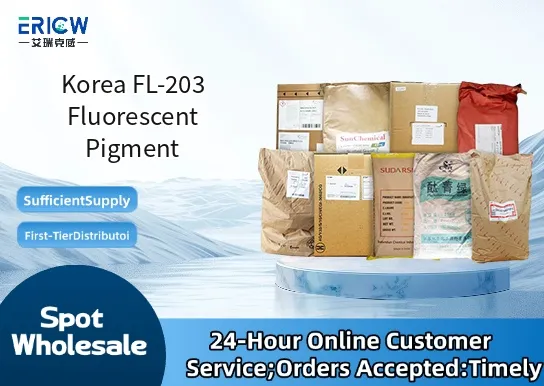
Q1: What is the primary chemical composition of Korea FL-203?
A: Korea FL-203 is a high-performance organic fluorescent pigment based on a proprietary benzoxazole derivative system, engineered for intense chromaticity and photostability under UV excitation. It does not contain heavy metals or regulated fluorophores.
Q2: Is FL-203 suitable for use in polymer masterbatches?
A: Yes — FL-203 exhibits excellent thermal stability up to 260°C and good dispersibility in polyolefins, PS, ABS, and engineering thermoplastics. It is widely used in extrusion-grade masterbatches where brightness and batch-to-batch consistency are critical.
Q3: How does FL-203 perform under outdoor weathering conditions?
A: While inherently more sensitive to UV degradation than conventional pigments, FL-203 delivers enhanced outdoor durability when compounded with appropriate UV stabilizers and HALS systems. Performance varies significantly by matrix and formulation — accelerated weathering testing is recommended for end-use validation.
Q4: Can FL-203 be used in solvent-based coatings?
A: Yes — FL-203 shows good compatibility with aromatic and aliphatic hydrocarbon solvents, ketones, and ester-based systems. It requires proper wetting and stabilization during dispersion to prevent flocculation, especially in low-viscosity clear coats.
Q5: What safety handling precautions should be observed?
A: As with all fine organic pigments, avoid inhalation of dust during handling. Use local exhaust ventilation and wear appropriate PPE (e.g., N95 respirator, gloves, safety goggles). The material is non-toxic but not intended for food-contact or pharmaceutical applications unless specifically qualified.
Contact With Us:
E-mail: wangxingqiang@ericwchem.com
Have a Questions? Call Us:
Add:
Building A1, Jiete Industrial Park, Huangpu District, Guangzhou City, Guangdong Province, China