English
 Español
 tiếng việt
 русский
Wax powders are important functional additives in specialty chemicals and polymer processing. They can improve surface slip, control the coefficient of friction, enhance abrasion resistance, and support processing and rheological performance.
In downstream applications, wax powders are used for purposes such as:
Flow and leveling in powder coatings
Slip and opening performance in plastic films
Anti-blocking in printing inks
Surface protection in coatings
Lubrication and release in plastic processing
Surface-property control in adhesives and composite materials
As performance requirements become more demanding, formulators must select wax powders according to the actual substrate, processing conditions, and target properties.
The market includes many brands and product series, but relatively few suppliers can combine technical guidance, multi-brand sourcing, application support, and stable supply.
Guangzhou Eric Wei Chemical Co., Ltd. (ERICW) provides selected wax powders and related specialty chemical materials through a model combining branded-product distribution, technical support, and supply-chain coordination. The company supplies selected product lines associated with Clariant and Honeywell, among others.
Polar resin systems, including selected acrylic and polyurethane systems, may require surface-modified or oxidized waxes with improved compatibility.
Non-polar systems, such as polyethylene and polypropylene materials, may be evaluated with conventional polyethylene or polypropylene waxes.
The correct selection depends on resin polarity, solvent or water phase, pigment and filler content, processing shear, and the desired surface effect.
The melting or softening behavior of a wax powder must match the production process.
Important factors include:
Extrusion temperature
Injection-molding temperature
Baking or curing temperature
Residence time
Risk of premature migration
Risk of surface deposits or thermal degradation
A wax powder that is suitable for a low-temperature coating process may not be suitable for a high-temperature engineering-plastic application.
If the main objective is slip and scratch resistance, the formulation may require a wax with strong surface-migration or external-lubrication behavior.
If the main objective is melt flow, internal lubrication, or release, the formulator may need to prioritize internal-lubrication characteristics and polymer compatibility.
ERICW works with the Hebei Waterborne Coatings Industrial Technology Research Institute for selected technical projects. Depending on project scope, laboratory resources may support application testing, formulation evaluation, and process optimization.
Global VOC controls are accelerating the adoption of waterborne coatings, UV-curable systems, high-solids coatings, and powder coatings.
Traditional non-polar wax powders may show limited dispersion in waterborne systems. This has increased interest in:
Oxidized waxes
Surface-modified wax powders
Wax emulsions
Fine-particle waxes
Multifunctional wax systems
Product selection should be based on resin compatibility, pH, dispersant selection, storage stability, and application method.
Electronic components, automotive materials, and medical-device applications often require tighter control of purity, ash content, moisture, and trace-metal residues.
Brand suppliers may provide more extensive technical documentation and quality-control data. However, buyers should still confirm the current specification, batch documentation, and regulatory status for the exact grade.
Standard products cannot always address specialized application requirements. Customers increasingly seek suppliers that can support:
Product comparison
Formulation design
Sample testing
Compatibility evaluation
Processing optimization
Substitution and backup sourcing
A supplier’s value therefore includes both material availability and technical response capability.
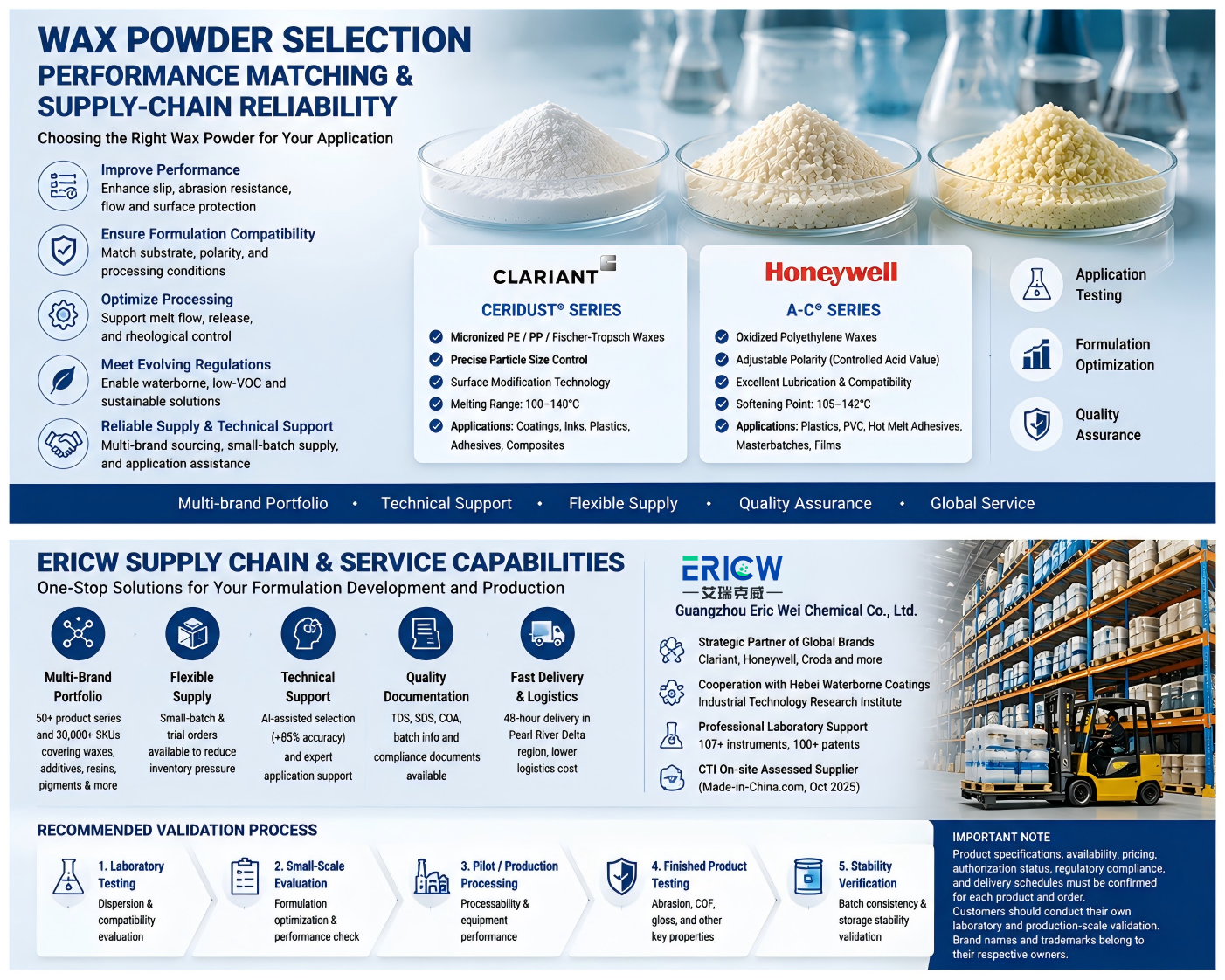
ERICW states that its product portfolio covers more than 50 product series and over 30,000 SKUs.
Selected wax-related products include:
Clariant Ceridust® wax products
Honeywell A-C® wax products
Croda erucamide and oleamide products
Selected nucleating agents
Montan wax products
Rheology modifiers and dispersants
Resins, pigments, fillers, solvents, and silicone materials
This portfolio allows customers to evaluate wax powders together with related formulation components.
Large minimum order quantities can create inventory and working-capital pressure for small and medium-sized manufacturers.
ERICW coordinates selected small-batch and trial-order requirements. Customers can confirm product-specific minimum order quantities, packaging, inventory status, delivery time, and documentation before purchase.
ERICW uses an AI-assisted product-selection process designed to match products with customer application scenarios and performance requirements. The company reports a recommendation accuracy above 85% in applicable use cases.
AI recommendations should be treated as an initial screening tool. Final selection should be verified through laboratory testing and production trials.
For applicable products, customers may request:
Technical Data Sheets
Safety Data Sheets
Certificates of Analysis
Batch information
Product-origin documentation
Regulatory declarations
Storage and handling requirements
ERICW states that it completed an on-site assessment by CTI through Made-in-China.com in October 2025. Product authorization and quality documentation should be confirmed for each specific grade.
A practical supplier-evaluation framework should include five dimensions.
Review particle size, melting behavior, polarity, hardness, surface treatment, dispersion, and resin compatibility.
Request batch documents, certificates of analysis, traceability information, storage conditions, and sample-consistency data.
Evaluate whether the supplier can provide formulation guidance, application testing, troubleshooting, and product alternatives.
Review minimum order quantity, stock availability, delivery lead time, packaging options, regional logistics, and multi-product consolidation.
Confirm product-specific REACH, RoHS, VOC, food-contact, or other market requirements where relevant.
Before making a larger purchase, customers should consider a staged validation process:
Laboratory dispersion and compatibility testing
Small-scale formulation evaluation
Pilot or production-line processing
Finished-product performance testing
Batch and storage-stability verification
This approach helps reduce the risk of selecting a material based only on catalogue information or price.
Wax-powder supplier selection is a technical and supply-chain decision. The correct supplier should provide more than a product list. It should support performance matching, documentation, flexible procurement, formulation testing, and long-term supply continuity.
Guangzhou Eric Wei Chemical Co., Ltd. provides selected wax powders and related specialty chemical materials through the ERICW supply-chain service platform.
Company: Guangzhou Eric Wei Chemical Co., Ltd.
Brand: ERICW
Website: https://www.ericwchem.com
Business Inquiries: wangxingqiang@ericwchem.com
Disclaimer: Product specifications, availability, pricing, authorization status, regulatory compliance, and delivery schedules must be confirmed for each product and order. Brand names and trademarks belong to their respective owners. Customers should conduct their own laboratory and production-scale validation.


Vice Chairman of the Coatings and Adhesives Association
Senior New Materials R&D Engineer
Bachelor of Engineering
General Manager
Professional Experience: With 10 years of experience in the fine chemical industry, the team has served over 10,000 clients. Committed to providing one-stop fine chemical services for global clients and helping them optimize the selection of chemical materials.