English
 Español
 tiếng việt
 русский
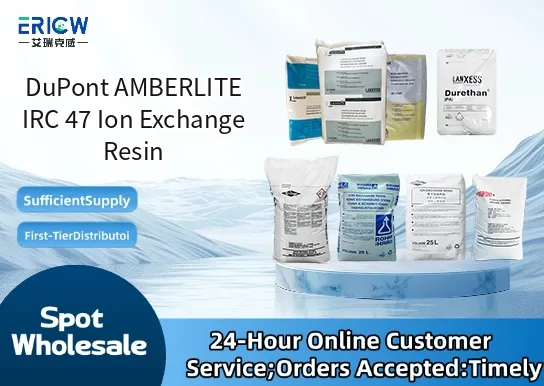
High-capacity, strong-acid cation exchange resin with sulfonic acid functional groups.
Optimized particle size distribution for low pressure drop and high flow rate operation.
Excellent physical and chemical stability across wide pH (0–14) and temperature ranges (up to 120 °C).
Consistent spherical bead morphology ensuring uniform hydraulic performance and reduced channeling.
Low soluble organic content (SOC), minimizing post-treatment contamination in ultrapure water systems.
Ultrapure water (UPW) polishing in semiconductor manufacturing.
Pharmaceutical-grade water purification for injectables and APIs.
Pretreatment and demineralization in power plant boiler feedwater systems.
Removal of heavy metal cations (e.g., Cu²⁺, Ni²⁺, Zn²⁺) from industrial wastewater.
Catalyst support and metal recovery in hydrometallurgical processes.
| Chemical Type | Strong-acid cation exchange resin (sulfonated polystyrene-divinylbenzene) |
| Product Form | Moist, spherical beads |
| Appearance | Opaque amber to brown beads |
| Functional Group | Sulfonic acid (–SO₃H) |
| Ion Form | H⁺ form (ready-to-use) |
| Moisture Content | 45–50% (as shipped) |
| Particle Size Range | 300–1200 µm (95% retained on 20 mesh, passes 50 mesh) |
| Uniformity Coefficient | ≤ 1.6 |
Q1: What is the primary functional group and ionic form of AMBERLITE IRC 47?
A: AMBERLITE IRC 47 is a strongly acidic cation exchange resin with sulfonic acid functional groups, supplied in the sodium (Na⁺) form. It is designed for high-capacity removal of divalent and multivalent cations from aqueous solutions.
Q2: Can AMBERLITE IRC 47 be used for demineralization or softening of industrial process water?
A: Yes — it is commonly employed in water softening applications due to its high selectivity for calcium and magnesium ions over sodium. While effective for hardness removal, full demineralization typically requires pairing with an anion exchange resin in a mixed-bed or two-bed configuration.
Q3: How does AMBERLITE IRC 47 compare to gel-type resins in terms of physical stability and operating pH range?
A: As a macroporous resin, IRC 47 offers superior mechanical strength and oxidative stability compared to conventional gel-type cation exchangers. It maintains consistent performance across a broad pH range (typically 0–14) and is less prone to osmotic shock during regeneration cycles.
Q4: Is AMBERLITE IRC 47 suitable for food-grade or pharmaceutical water purification?
A: Yes — it is manufactured and tested to meet requirements for use in purified water systems supporting food, beverage, and pharmaceutical applications, subject to proper validation, regeneration protocols, and compliance with relevant local regulatory expectations for ion exchange materials.
Q5: What are key considerations for regenerating AMBERLITE IRC 47 after exhaustion?
A: Regeneration is typically performed using a sodium chloride brine solution. Optimal efficiency depends on contact time, brine concentration, flow rate, and bed depth. Thorough rinsing post-regeneration is essential to remove residual chloride and ensure stable effluent quality before service.
Contact With Us:
E-mail: wangxingqiang@ericwchem.com
Have a Questions? Call Us:
Add:
Building A1, Jiete Industrial Park, Huangpu District, Guangzhou City, Guangdong Province, China