English
 Español
 tiếng việt
 русский
SEO title: BENTONE SD-2 Supplier and Application Guide for Industrial Coatings
Meta description: Learn how to evaluate Elementis BENTONE® SD-2 organoclay for thixotropy, anti-settling, and anti-sag control in solventborne coatings, inks, and adhesives.
Suggested slug: /bentone-sd-2-organoclay-rheology-additive-guide
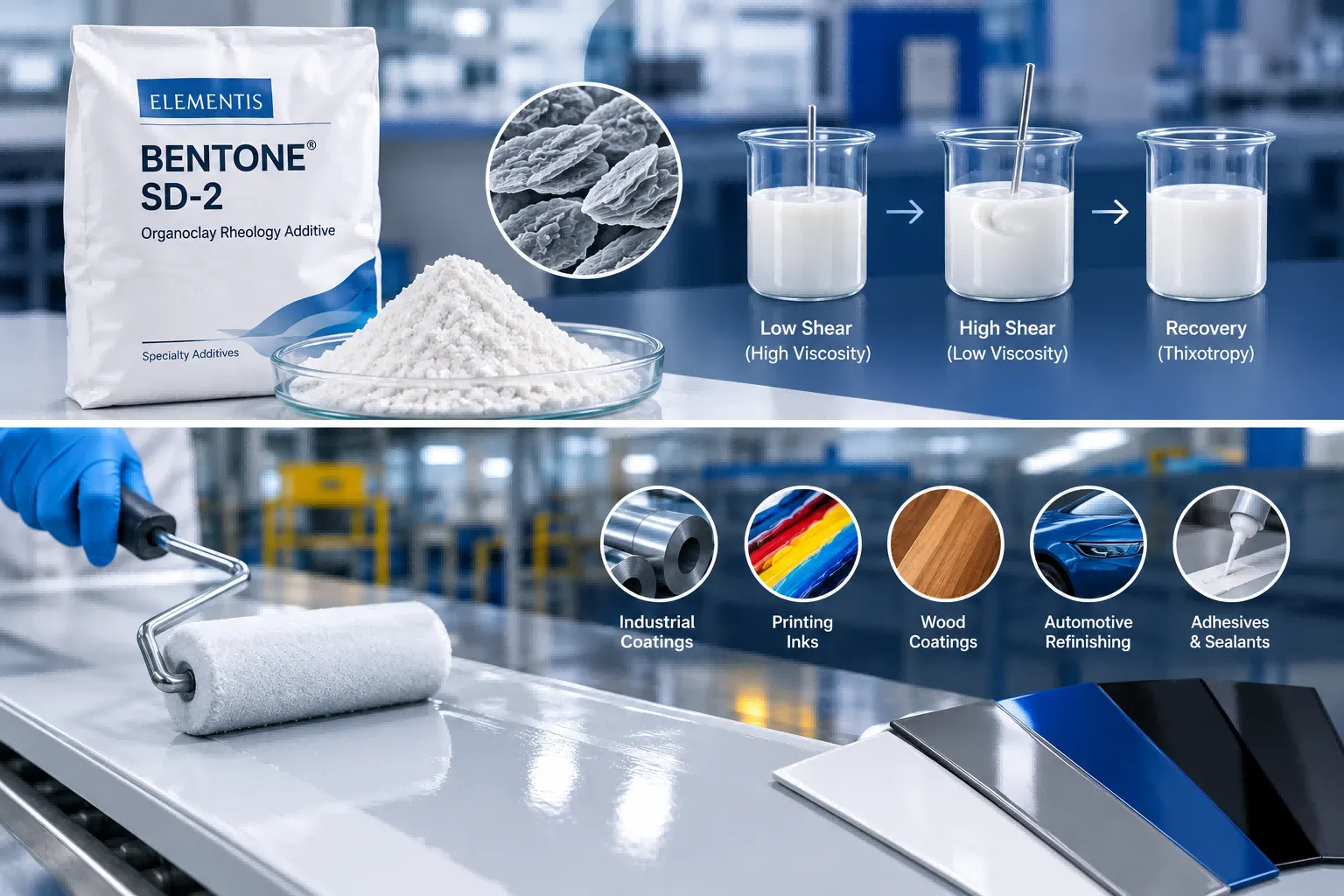
Elementis BENTONE® SD-2 is an organoclay-based rheology additive used in selected solventborne formulation systems. Product literature commonly describes BENTONE SD-2 as an organic derivative of bentonite clay designed for moderate- to high-polarity solvent systems, including systems containing ketones and esters.
The exact product classification, surface treatment, dispersion behavior, recommended dosage, and compatible solvent range must be confirmed in the latest official Elementis technical documentation.
Reference: Elementis BENTONE SD-2 technical data
BENTONE SD-2 should be evaluated as a rheology modifier rather than treated as a universal additive for every coating system. Waterborne applications, low-polarity solvent systems, and high-solid formulations may require different grades or additional compatibility testing.
Organoclay particles can form a temporary three-dimensional structure in a compatible liquid phase. This structure changes with shear:
Higher apparent viscosity during storage
Lower viscosity during mixing or application
Recovery of structure after shear is reduced
Improved resistance to pigment and filler settling
Better control of sagging on vertical surfaces
This “high viscosity at rest and lower viscosity under shear” behavior is commonly described as thixotropy.
The final result depends on:
Solvent polarity and composition
Resin or binder chemistry
Pigment and filler loading
Additive concentration
Dispersion equipment
Mixing speed and time
Addition order
Chemical activation, where required
Temperature and storage conditions
A grade that performs well in one solvent system may produce a different viscosity profile in another. Testing in the actual formulation is therefore necessary.
BENTONE® SD-2 may be evaluated for rheology control, anti-settling, and anti-sag performance in metal coatings, protective coatings, equipment finishes, and high-build formulations.
Testing should examine:
Low-shear viscosity
High-shear application viscosity
Sag resistance
Pigment suspension
Storage stability
Leveling after application
Surface appearance
Automotive repair coatings require a balance between sprayability, anti-sag behavior, leveling, and gloss. Organoclay selection should be tested with the actual binder, solvent blend, pigment package, and spray process.
In wood coatings, the additive should be evaluated for transparency, gloss, surface feel, sanding behavior, viscosity recovery, and compatibility with the curing system.
Ink formulators should check dispersion quality, printability, viscosity, gloss, transparency, settling, and long-term storage behavior.
BENTONE® SD-2 or a related organoclay grade may be considered for viscosity adjustment, filler suspension, and sag control in selected adhesive and sealant systems. Compatibility with the polymer, plasticizer, curing agent, and adhesion performance must be verified.
Settling may result from insufficient low-shear structure, poor particle wetting, inadequate dispersion, or incompatibility between the organoclay and solvent phase.
Possible investigation items include:
Solvent polarity
Pigment and filler density
Dispersion energy
Additive addition order
Activation method
Final viscosity at low shear
A high viscosity increase may be associated with excessive dosage, unsuitable solvent compatibility, over-activation, poor dispersion, or interaction with other additives.
The correction should be based on rheology data rather than simply reducing the additive concentration.
An overly strong thixotropic structure can affect spray atomization, brushability, roller application, leveling, or surface smoothness. High-shear viscosity and recovery behavior should be evaluated together.
Batch variation can result from differences in raw materials, moisture exposure, packaging integrity, dispersion process, or storage history. Product documentation and retained-sample comparison are useful for quality control.
The processing route should follow the official product guidance and the customer’s equipment.
A practical development workflow includes:
Confirm the solvent and binder system.
Review the latest Elementis TDS and SDS.
Select a starting dosage range for laboratory screening.
Compare direct addition with pre-dispersion where applicable.
Record mixing speed, shear level, temperature, and processing time.
Measure low-shear and high-shear viscosity.
Evaluate settling, sagging, leveling, and surface appearance.
Validate the selected formula in pilot production.
Some organoclay systems require a suitable polar activator or activation step. The activator type, amount, and handling requirements must follow the official technical guidance and applicable safety procedures. Methanol, ethanol, propylene carbonate, and other solvents should not be added automatically without compatibility and safety review.
When sourcing BENTONE® SD-2, buyers should request:
Exact product grade and designation
Original packaging information
Batch or lot number
Current TDS and SDS
Certificate of Analysis (COA)
Product origin and traceability documents
Storage conditions
Remaining shelf life
Current distribution or authorization information where applicable
Sample or trial-order availability
Delivery lead time
Total delivered cost
A supplier should be evaluated on both product documentation and service capability. Product price, freight, packaging, laboratory testing, inventory exposure, and potential rework should be included in the purchasing calculation.
Guangzhou Eric Wei Chemical Co., Ltd. (ERICW) is a specialty chemical sourcing and supply-chain service provider headquartered in Guangzhou, China.
According to company information, ERICW supports:
Product sourcing
TDS, SDS, and COA coordination
Small-batch purchasing
Multi-product order consolidation
Formulation communication
Sample testing coordination
Logistics and export support
Company materials list selected Elementis product families, including BENTONE® 27, BENTONE® 34, BENTONE® 38, BENTONE® SD-1, and BENTONE® SD-2. Product availability, packaging, distribution rights, origin, and technical parameters should be confirmed for each transaction.
ERICW reports that its founding team has more than ten years of specialty chemical experience. The company also reports cooperation with the Hebei Waterborne Coatings Industrial Technology Research Institute and access to analytical resources for formulation and material evaluation.
Possible technical coordination for BENTONE® SD-2 may include:
Solvent-polarity review
Grade comparison
Dispersion-process discussion
Dosage screening
Low-shear and high-shear rheology testing
Settling and sag evaluation
Compatibility review with defoamers, wetting agents, and dispersants
Alternative-grade comparison
ERICW also reports using an AI-assisted product-selection process. Such recommendations should be treated as an initial screening tool and verified through laboratory and production testing.
Elementis product families may include several BENTONE® and SD-series grades. Their suitability should not be inferred from the product name alone.
When comparing BENTONE® SD-2 with BENTONE® 27, BENTONE® 34, BENTONE® 38, or SD-1, compare:
Intended solvent polarity
Dispersion method
Activation requirement
Low-shear viscosity
High-shear viscosity
Thixotropic recovery
Storage stability
Sag resistance
Effect on leveling and surface appearance
Compatibility with the customer’s binder
Alternative organoclay grades from other manufacturers should be evaluated through the same test protocol.
Prepare a dosage ladder using the current official TDS as the starting reference. Record viscosity, dispersion time, fineness, appearance, and settling behavior.
Apply the formulation by the intended spray, brush, roller, or drawdown method. Evaluate sagging, leveling, gloss, surface texture, and film uniformity.
Monitor viscosity, settling, hard cake formation, redispersibility, and appearance during storage under representative conditions.
Confirm performance with production equipment, actual batch size, process temperature, and normal raw-material variation.
Retain samples, compare batch COAs, monitor moisture exposure, and document deviations in viscosity or application behavior.
It is an Elementis organoclay rheology additive used in selected solventborne formulation systems. The latest official TDS should be used to confirm its technical position and recommended applications.
Do not assume so. Waterborne coatings require a grade specifically compatible with the water phase and the selected binder. Confirm suitability through the current TDS and testing.
Public technical material describes it for moderate- to high-polarity solvent systems, including systems containing ketones and esters. The actual solvent blend must be checked against the current official documentation.
There is no universal dosage. The use level depends on solvent composition, binder, pigment loading, target viscosity, application method, and dispersion process.
A replacement may be possible, but the products are not automatically interchangeable. Compare dispersion, viscosity, thixotropic recovery, settling, sag resistance, and final coating appearance.
Buyers may contact the manufacturer, an authorized regional distributor, or a specialty chemical sourcing company. Product origin, authorization, packaging, documents, stock, and delivery terms should be verified before purchase.
Company: Guangzhou Eric Wei Chemical Co., Ltd.
Brand: ERICW
Website: https://www.ericwchem.com
Business inquiries: wangxingqiang@ericwchem.com
This material is for marketing reference only and does not replace professional technical, legal or procurement advice. Product parameters, prices, certifications and supply status vary by batch and market. Customers must check official TDS/SDS/COA and perform self-testing before purchase.
All stated performance data and business information require independent verification. All trademarks are proprietary to their respective holders without implied partnership or endorsement.

Vice Chairman of the Coatings and Adhesives Association
Senior New Materials R&D Engineer
Bachelor of Engineering
General Manager
Professional Experience: With 10 years of experience in the fine chemical industry, the team has served over 10,000 clients. Committed to providing one-stop fine chemical services for global clients and helping them optimize the selection of chemical materials.
This is the last one.