English
 Español
 tiếng việt
 русский
Broad-spectrum activity against key ascomycete and basidiomycete pathogens, including powdery mildew, rusts, and leaf spots.
Systemic translaminar movement ensures protective and curative action within plant tissues.
Low phytotoxicity profile validated across major horticultural and field crops under recommended use rates.
Compatible with integrated pest management (IPM) programs and common adjuvants and pesticides.
Stable formulation with extended shelf life (>24 months at 5–30°C in original sealed container).
Vineyards – control of *Uncinula necator* (powdery mildew) on grapevines.
Apple orchards – management of *Venturia inaequalis* (apple scab) during pre-bloom and petal fall stages.
Cereal production – suppression of *Puccinia recondita* (brown rust) and *Blumeria graminis* (powdery mildew) on wheat and barley.
Protected horticulture – disease prevention in greenhouse tomatoes and cucumbers.
Professional turf management – curative treatment for *Rhizoctonia solani* (brown patch) on golf course fairways and sports fields.
| Chemical Type | Triazole-class fungicide (active ingredient: tebuconazole) |
| Product Form | Emulsifiable concentrate (EC) |
| Appearance | Amber to light brown homogeneous liquid |
| Active Ingredient Concentration | 200 g/L tebuconazole |
| Density (20°C) | 1.08–1.12 g/cm³ |
| pH Range (1% aqueous solution) | 6.0–7.5 |
| Solubility in Water | 49 mg/L at 20°C |
| Primary Applications | Foliar spray for preventive and early curative disease control |
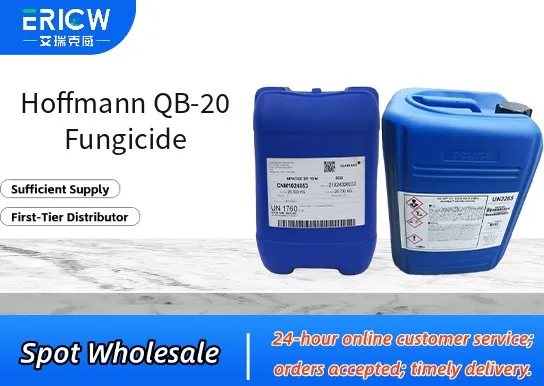
Q1: What types of fungi does Hoffmann QB-20 effectively control?
A: Hoffmann QB-20 is a broad-spectrum fungicide designed to inhibit the growth of common spoilage and pathogenic fungi in industrial formulations, including Aspergillus, Penicillium, Cladosporium, and yeasts such as Candida and Rhodotorula. Its efficacy is particularly notable in water-based systems prone to microbial degradation.
Q2: In which product categories is Hoffmann QB-20 typically incorporated?
A: It is widely used in industrial maintenance coatings, metalworking fluids, latex paints, adhesives, sealants, and non-food-contact cleaning concentrates—where long-term preservation against fungal contamination is required without compromising formulation stability or performance.
Q3: How should Hoffmann QB-20 be added to a formulation?
A: QB-20 is fully compatible with most aqueous systems and can be added during the final stage of manufacturing, either neat or pre-diluted in water or a suitable co-solvent. For optimal dispersion and stability, it is recommended to add under mild agitation and ensure pH remains within the typical range of 4–9.
Q4: Is Hoffmann QB-20 compatible with common biocides used for bacterial control?
A: Yes, QB-20 demonstrates good compatibility with many isothiazolinone-based and formaldehyde-releasing preservatives when used at recommended levels. Synergistic effects may occur in dual-preservative systems, though compatibility testing under actual formulation conditions is advised prior to full-scale implementation.
Contact With Us:
E-mail: wangxingqiang@ericwchem.com
Have a Questions? Call Us:
Add:
Building A1, Jiete Industrial Park, Huangpu District, Guangzhou City, Guangdong Province, China