English
 Español
 tiếng việt
 русский
Excellent flexibility and impact resistance at low temperatures down to –30°C.
Superior adhesion to diverse substrates including metals, plastics, and composites.
Low-VOC formulation compliant with major industrial emission regulations.
Fast room-temperature cure profile without requiring external heat or catalysts.
Outstanding chemical resistance to aliphatic hydrocarbons, lubricants, and mild aqueous solutions.
Automotive underbody coatings and chassis protection systems.
Industrial elastomeric sealants for vibration-damping components.
Protective coatings for wind turbine blade leading edges.
Flexible encapsulants for electronic modules exposed to thermal cycling.
Adhesive binders in high-performance composite laminates.
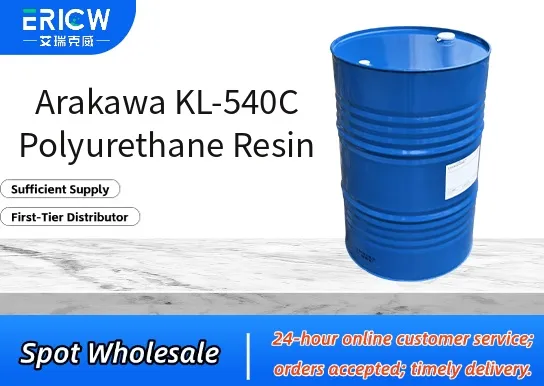
| Chemical Type | Aromatic polyurethane pre-polymer (NCO-terminated) |
| Product Form | Clear to pale amber liquid |
| Appearance | Homogeneous, low-viscosity liquid |
| NCO Content (wt%) | 3.8–4.2% |
| Viscosity @ 25°C (mPa·s) | 1,200–1,800 |
| Density @ 25°C (g/cm³) | 1.08–1.12 |
| Shelf Life (unopened, 15–25°C) | 12 months |
| Primary Applications | Coatings, adhesives, sealants, and elastomers (CASE) |
Q1: What is the primary function of KL-540C in polyurethane systems?
A: KL-540C is a reactive polyurethane resin designed to enhance crosslink density and improve mechanical performance—particularly abrasion resistance, flexibility retention, and chemical durability—in two-component PU coatings, adhesives, and elastomers.
Q2: Is KL-540C compatible with aromatic and aliphatic isocyanates?
A: Yes, KL-540C demonstrates broad compatibility with both aromatic (e.g., MDI, TDI) and aliphatic (e.g., HDI, IPDI) isocyanate components, making it suitable for formulations requiring either UV stability or higher reactivity depending on end-use requirements.
Q3: How should KL-540C be stored to maintain optimal reactivity?
A: Store in tightly sealed containers under dry, cool conditions (below 30 °C), protected from moisture and direct sunlight. Prolonged exposure to humidity may lead to premature reaction or viscosity increase due to its hydroxyl functionality.
Q4: Can KL-540C be used in solvent-free or high-solids PU formulations?
A: Yes—KL-540C has relatively low volatility and good compatibility with reactive diluents and high-molecular-weight polyols, supporting its use in low-VOC and solvent-free PU systems without compromising pot life or film formation.
Q5: Does KL-540C require special handling during formulation?
A: As with all polyurethane resins containing active hydroxyl groups, standard industrial hygiene practices apply: use appropriate PPE, ensure adequate ventilation, and avoid contact with strong acids or moisture sources prior to curing.
Contact With Us:
E-mail: wangxingqiang@ericwchem.com
Have a Questions? Call Us:
Add:
Building A1, Jiete Industrial Park, Huangpu District, Guangzhou City, Guangdong Province, China