English
 Español
 tiếng việt
 русский
Excellent film-forming ability with high gloss and clarity after drying.
Low VOC content (< 50 g/L), compliant with stringent environmental regulations including EU REACH and US EPA standards.
Good hydrolytic stability and storage stability at ambient temperature (12 months shelf life in sealed container).
Outstanding flexibility, abrasion resistance, and adhesion to diverse substrates including plastics, metals, and coated papers.
Easily adjustable viscosity for spray, roller, or dip coating applications without requiring additional co-solvents.
Topcoats for automotive interior trim and instrument panels.
Protective clear coats for flexible packaging laminates and metallized films.
Surface coatings for premium leather goods and synthetic leather substrates.
Functional overprint varnishes in high-end label and folding carton printing.
Water-based ink binder component for gravure and flexographic decorative inks.
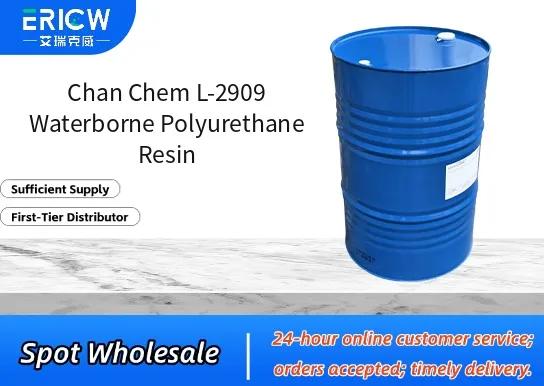
| Chemical Type | Anionic aliphatic waterborne polyurethane dispersion |
| Product Form | Ready-to-use aqueous dispersion |
| Appearance | Translucent, slightly bluish milky liquid |
| pH (25°C) | 7.8 – 8.5 |
| Solids Content (wt%) | 30.0 ± 1.0% |
| Viscosity (mPa·s, Brookfield RVT, #2 spindle, 20 rpm, 25°C) | 150 – 400 |
| Particle Size (D50, nm) | 80 – 120 |
| Minimum Film-Forming Temperature (MFFT) | 12 – 16°C |
Q1: What are the primary application areas for Chan Chem L-2909?
A: Chan Chem L-2909 is widely used in high-performance waterborne coatings for flexible substrates, including synthetic leather finishing, textile coatings, and soft-touch decorative films. Its excellent film-forming ability and low-temperature coalescence make it especially suitable for heat-sensitive materials.
Q2: How does L-2909 compare to solvent-based polyurethane resins in terms of performance?
A: L-2909 delivers comparable flexibility, abrasion resistance, and chemical durability to many solvent-based alternatives while significantly reducing VOC emissions and improving workplace safety. It offers good hydrolytic stability and maintains mechanical integrity after repeated flexing or washing—key advantages for end-use applications requiring sustainability without compromise.
Q3: Can L-2909 be blended with other waterborne polymers, such as acrylics or styrene-acrylics?
A: Yes, L-2909 demonstrates good compatibility with common waterborne acrylic and styrene-acrylic dispersions. Blending can help tailor film hardness, gloss, and cost-performance balance—though compatibility testing under intended processing and drying conditions is recommended prior to full-scale formulation.
Q4: What are the key handling and storage recommendations?
A: Store L-2909 in tightly sealed containers at temperatures between 5°C and 35°C, avoiding freezing and prolonged exposure to direct sunlight. Prior to use, stir gently to ensure homogeneity; avoid high-shear mixing that may destabilize the dispersion. For optimal shelf life, use within 12 months from date of manufacture when stored under recommended conditions.
Contact With Us:
E-mail: wangxingqiang@ericwchem.com
Have a Questions? Call Us:
Add:
Building A1, Jiete Industrial Park, Huangpu District, Guangzhou City, Guangdong Province, China