English
 Español
 tiếng việt
 русский
High thermal stability up to 800°C, suitable for high-temperature processing environments.
Excellent lightfastness and weather resistance, maintaining color integrity under prolonged UV exposure.
Non-toxic and heavy-metal-free formulation compliant with global regulatory standards including EN 71-3 and RoHS.
Superior dispersion performance in aqueous and solvent-based systems with low viscosity impact.
Consistent batch-to-batch color reproducibility ensured by stringent QC protocols and ISO 9001-certified manufacturing.
Ceramic glazes and frits for architectural tiles and tableware.
High-performance concrete and cementitious coatings.
Plastic coloration for outdoor applications including automotive trim and construction profiles.
Industrial powder coatings requiring heat resistance and long-term durability.
Specialty inks for packaging films exposed to sterilization or outdoor storage.
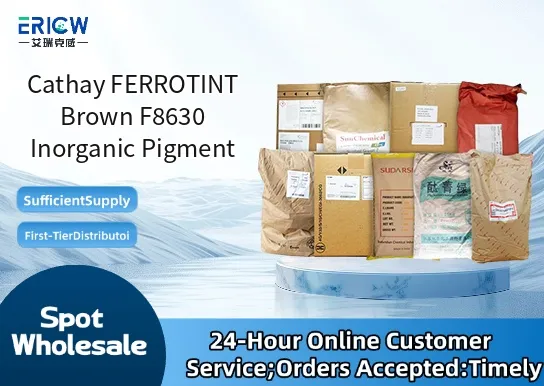
| Chemical Type | Complex iron oxide-based inorganic pigment |
| Product Form | Free-flowing dry powder |
| Appearance | Uniform reddish-brown powder with matte finish |
| Primary Applications | Ceramics, concrete, plastics, coatings, inks |
| Key Features | Heat stable, UV resistant, non-hygroscopic, chemically inert |
| Benefits | Low dosage requirement, excellent hiding power, pH-stable in alkaline media |
| Storage Conditions | Store in cool, dry place; protect from moisture and direct sunlight |
| Regulatory Compliance | REACH registered; compliant with FDA 21 CFR §178.3297 (indirect food contact) |
Q1: What is the primary chemical composition of Cathay FERROTINT Brown F8630?
A: Cathay FERROTINT Brown F8630 is a complex inorganic pigment based on iron oxide and manganese-modified spinel structures, engineered to deliver consistent warm brown coloration with enhanced thermal and light stability.
Q2: Is this pigment suitable for use in high-temperature polymer processing such as polypropylene or engineering thermoplastics?
A: Yes — F8630 exhibits excellent thermal stability and is routinely used in polymer coloration applications processed above 200 °C, including injection molding and extrusion of polyolefins and certain engineering plastics, without significant hue shift or degradation.
Q3: How does F8630 compare to organic brown pigments in terms of weather resistance and UV durability?
A: As an inorganic pigment, F8630 offers significantly superior resistance to UV radiation, heat, and atmospheric exposure compared to most organic brown alternatives, making it well-suited for exterior applications where long-term color retention is critical.
Q4: Can F8630 be dispersed in water-based systems for architectural coatings or ink formulations?
A: Yes — F8630 is compatible with both aqueous and solvent-based systems. With appropriate dispersants and milling protocols, it achieves stable, uniform dispersion in waterborne architectural paints, industrial coatings, and pigment concentrates.
Q5: What is the typical dosage range when using F8630 in plastic masterbatches?
A: Dosage depends on the desired shade intensity and base polymer, but F8630 is generally effective at low concentrations — typically ranging from 0.1% to 2% by weight in masterbatch formulations.
Contact With Us:
E-mail: wangxingqiang@ericwchem.com
Have a Questions? Call Us:
Add:
Building A1, Jiete Industrial Park, Huangpu District, Guangzhou City, Guangdong Province, China