English
 Español
 tiếng việt
 русский
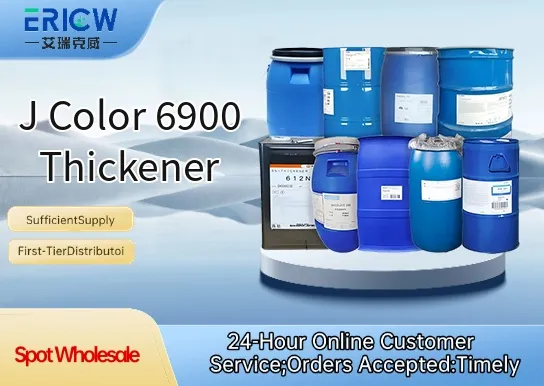
High-efficiency rheology modifier for water-based systems.
Excellent compatibility with anionic, nonionic, and cationic surfactants.
Provides outstanding shear-thinning behavior and sag resistance.
Stable performance across pH range 4–10 without requiring neutralization.
Low-odor, non-toxic formulation compliant with major global safety standards.
Architectural coatings (interior/exterior latex paints).
Industrial maintenance coatings and protective finishes.
Water-based inks and pigment dispersions.
Construction adhesives and tile grouts.
Textile printing pastes and functional finishing formulations.
| Chemical Type | Hydrophobically modified alkali-swellable emulsion (HASE) |
| Product Form | White to off-white viscous liquid |
| Appearance | Homogeneous, slightly opalescent dispersion |
| pH (1% aqueous solution) | 3.0–4.5 |
| Solids Content (wt%) | 28.0 ± 1.0 |
| Viscosity (Brookfield, RVT, spindle #3, 20 rpm, 25°C) | 15,000–25,000 cP |
| Primary Applications | Rheology control in waterborne coatings, inks, and adhesives |
| Key Features | Non-ionic thickening mechanism, low foam generation, excellent freeze-thaw stability |
Q1: What types of formulations is J Color 6900 Thickener typically used in?
A: J Color 6900 Thickener is primarily designed for water-based industrial coatings, architectural paints, and pigment dispersions where stable rheology control and good shear-thinning behavior are required. It performs well in both acrylic and styrene-acrylic systems.
Q2: How should J Color 6900 Thickener be incorporated into a formulation?
A: It is recommended to pre-dilute J Color 6900 in water or a compatible co-solvent before addition to the main batch. Incorporation under moderate agitation helps ensure uniform dispersion and avoids localized overdosing or gel formation.
Q3: Does J Color 6900 Thickener affect color development or gloss in finished films?
A: When used at typical dosage levels, J Color 6900 exhibits minimal impact on color strength, hue stability, or film gloss—making it suitable for high-appearance applications where optical consistency is critical.
Q4: Is J Color 6900 Thickener compatible with common biocides and defoamers?
A: Yes, J Color 6900 demonstrates broad compatibility with widely used isothiazolinone and benzisothiazole-based biocides, as well as silicone and non-silicone defoamers—though compatibility testing under actual formulation conditions is always advised.
Contact With Us:
E-mail: wangxingqiang@ericwchem.com
Have a Questions? Call Us:
Add:
Building A1, Jiete Industrial Park, Huangpu District, Guangzhou City, Guangdong Province, China