English
 Español
 tiếng việt
 русский
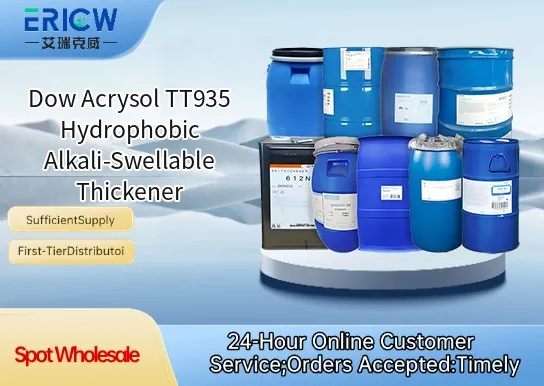
Delivers high mid-shear viscosity for excellent sag resistance in architectural coatings.
Provides superior hydrophobic character, enhancing water resistance and wet-film integrity.
Offers robust rheology control with low sensitivity to electrolytes and surfactants.
Enables efficient thickening upon alkaline activation without requiring high pH adjustment.
Delivers outstanding compatibility with acrylic and styrene-acrylic latexes commonly used in premium paints.
Interior and exterior architectural flat and low-sheen latex paints.
Textured decorative coatings and elastomeric wall systems.
Water-based primers and sealers requiring balanced flow and leveling.
Industrial maintenance coatings where water resistance and film durability are critical.
High-solid, low-VOC formulations seeking efficient rheology modification.
| Chemical Type | Hydrophobically modified alkali-swellable emulsion (HASE) |
| Product Form | Aqueous dispersion |
| Appearance | White to off-white opaque liquid |
| pH (as received) | 2.5–4.0 |
| Active Content | 28–30 wt% |
| Viscosity (Brookfield RVT, Spindle #3, 20 rpm, 25°C) | 1,000–3,000 cP |
| Primary Applications | Architectural coatings, industrial maintenance coatings, textured finishes |
| Key Features | Hydrophobicity-enhanced, alkali-activated, shear-thinning rheology |
Q1: How does Acrysol TT935 differ from conventional alkali-swellable thickeners?
A: Acrysol TT935 is a hydrophobic alkali-swellable emulsion (HASE) thickener, designed to provide enhanced rheology control and improved compatibility with surfactants and co-solvents compared to traditional ASE thickeners. Its hydrophobic modification enables better film formation, reduced water sensitivity, and improved resistance to shear during application.
Q2: What types of formulations is Acrysol TT935 typically used in?
A: It is widely used in architectural coatings—including interior and exterior flat and low-sheen paints—as well as industrial maintenance coatings and some specialty waterborne adhesives where robust viscosity build, sag resistance, and spatter control are required.
Q3: How should Acrysol TT935 be incorporated into a formulation?
A: It is generally added late in the let-down stage, after pH adjustment to ≥8.0, to ensure optimal swelling and performance. Pre-dilution with water or compatible solvent may aid dispersion, and gentle mixing is recommended to avoid excessive air entrapment.
Q4: Does Acrysol TT935 offer any advantages in freeze-thaw stability?
A: When properly formulated—particularly with appropriate co-thickeners and stabilizers—Acrysol TT935 contributes to improved rheological recovery after freeze-thaw cycling, helping maintain consistent viscosity and application properties across temperature variations.
Contact With Us:
E-mail: wangxingqiang@ericwchem.com
Have a Questions? Call Us:
Add:
Building A1, Jiete Industrial Park, Huangpu District, Guangzhou City, Guangdong Province, China