English
 Español
 tiếng việt
 русский
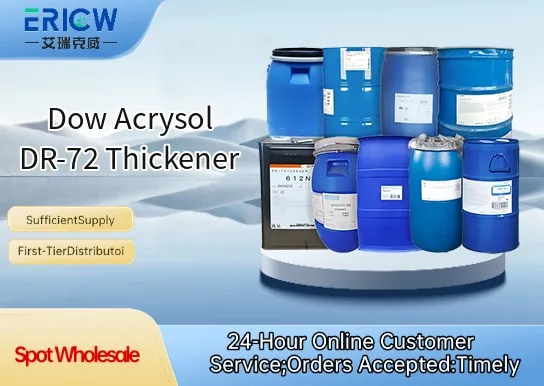
High-shear rheology modifier delivering excellent sag resistance in vertical applications.
Enables efficient viscosity build with low dosage requirements, reducing formulation costs.
Provides outstanding compatibility with anionic and nonionic surfactants commonly used in industrial cleaners and coatings.
Delivers stable, non-dripping performance across a broad pH range (pH 4–12).
Offers freeze-thaw stability in water-based systems without compromising thickening efficiency.
Architectural and industrial waterborne paints and coatings.
Heavy-duty liquid detergents and institutional cleaning formulations.
Water-based adhesives and sealants requiring controlled flow and anti-sag properties.
Textile printing pastes and pigment dispersions.
Agrochemical suspension concentrates (SCs) and aqueous pesticide formulations.
| Chemical Type | Acrylic copolymer (anionic, associative) |
| Product Form | Aqueous dispersion |
| Appearance | Opaque white to off-white liquid |
| pH (as supplied, 1% solution) | 3.5 – 4.5 |
| Active Content (wt%) | 28 – 32% |
| Viscosity (Brookfield RVT, spindle #3, 20 rpm, 25°C) | 500 – 1,500 cP |
| Specific Gravity (25°C) | 1.02 – 1.06 |
| Freeze-Thaw Stability | Stable after three cycles (-18°C for 16 h / 25°C for 8 h) |
Q1: What is the primary function of Acrysol DR-72 in water-based formulations?
A: Acrysol DR-72 is a hydrophobically modified alkali-swellable emulsion (HASE) thickener designed to provide efficient rheology control—particularly high-shear viscosity and sag resistance—in aqueous systems such as architectural coatings, adhesives, and cleaners.
Q2: How does Acrysol DR-72 differ from traditional ASE or HEC thickeners?
A: Unlike conventional alkali-swellable emulsions (ASE), DR-72 incorporates hydrophobic modifications that enable stronger associative network formation, resulting in superior flow and leveling balance, enhanced spatter resistance, and improved compatibility with surfactants and co-thickeners.
Q3: Is Acrysol DR-72 compatible with common biocides and defoamers used in industrial coatings?
A: Yes, DR-72 demonstrates broad compatibility with widely used isothiazolinone and formaldehyde-releasing biocides, as well as silicone and mineral oil-based defoamers—though compatibility should always be verified in the final formulation due to system-specific interactions.
Q4: What pH range is required for optimal performance of Acrysol DR-72?
A: DR-72 requires alkaline activation and performs best in formulations with pH ≥ 8.0; typical use involves post-addition adjustment to pH 8.5–9.5 using common neutralizing agents like AMP-95 or NaOH.
Q5: Can Acrysol DR-72 be used in low-VOC or zero-VOC formulations?
A: Yes, DR-72 is inherently low in VOC and supports compliance with stringent environmental regulations—it contains no added solvents or volatile organic carriers, making it suitable for low- and zero-VOC architectural and industrial coating systems.
Contact With Us:
E-mail: wangxingqiang@ericwchem.com
Have a Questions? Call Us:
Add:
Building A1, Jiete Industrial Park, Huangpu District, Guangzhou City, Guangdong Province, China