English
 Español
 tiếng việt
 русский
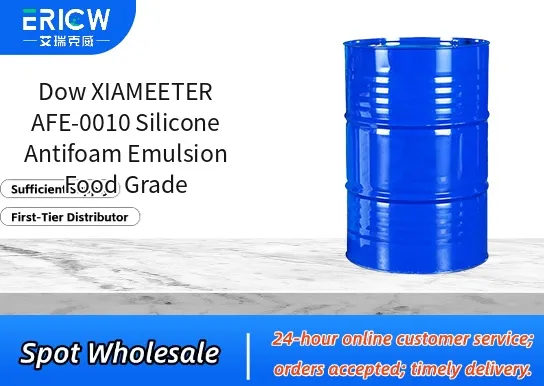
NSF Certified for direct food contact in accordance with NSF/ANSI Standard 60 and FDA-compliant for use in food processing applications.
Highly effective at low dosage levels, providing rapid foam suppression and long-lasting defoaming performance in aqueous systems.
Stable oil-in-water emulsion with excellent dispersion and compatibility in acidic, neutral, and mildly alkaline environments.
Non-ionic formulation ensures minimal interference with product functionality, taste, odor, or clarity.
Designed for easy handling and metering—ready-to-use liquid with no pre-dilution required.
Defoaming in sugar beet and cane syrup processing during evaporation and crystallization.
Foam control in starch hydrolysis, corn syrup production, and glucose manufacturing.
Antifoam agent in beverage production—including fruit juice, beer, and soft drink fermentation and filtration.
Suppression of entrained air and surface foam in dairy processing (e.g., whey protein concentration and UHT treatment).
Use in enzyme-based bioprocessing and pharmaceutical fermentation where food-grade compliance is mandatory.
| Chemical Type | Dimethyl silicone polymer emulsion |
| Product Form | White to off-white stable liquid emulsion |
| Appearance | Opaque, milky white liquid; slight opalescence when diluted |
| Primary Applications | Food processing, beverage manufacturing, starch & sweetener production |
| Key Features | NSF/ANSI 60 certified, FDA 21 CFR §173.350 compliant, non-ionic |
| Benefits | Low dosage efficacy, broad pH stability (pH 3–9), heat-resistant up to 120°C short-term |
| Storage Conditions | Store at 5–30°C; avoid freezing and prolonged exposure above 40°C |
| Shelf Life | 24 months from date of manufacture when stored under recommended conditions |
Q1: Is Dow XIAMEETER AFE-0010 compliant with food contact regulations?
A: Yes, this product is formulated and manufactured to meet global food-grade requirements for indirect food contact applications, including FDA 21 CFR §173.340 and EU Regulation (EC) No 1935/2004, subject to proper use in accordance with applicable good manufacturing practices.
Q2: What types of food processing operations is this antifoam emulsion typically used in?
A: It is commonly employed in high-shear or high-temperature food manufacturing processes where foam control is critical—such as in starch hydrolysis, enzyme-catalyzed reactions, fermentation broths, dairy processing, and plant-based beverage production.
Q3: How should Dow XIAMEETER AFE-0010 be incorporated into a food system?
A: It is recommended to add the emulsion during the early to mid-stage of processing, either neat or pre-diluted with water, with gentle agitation to ensure uniform dispersion. Avoid direct addition to highly acidic or highly alkaline streams without prior compatibility testing.
Q4: Does this silicone antifoam require post-process removal or filtration before packaging?
A: No—AFE-0010 is designed to remain stable and non-separating under typical food processing conditions, and it does not require removal or filtration. Residual levels are negligible and fully compatible with standard food safety assessments when used as directed.
Contact With Us:
E-mail: wangxingqiang@ericwchem.com
Have a Questions? Call Us:
Add:
Building A1, Jiete Industrial Park, Huangpu District, Guangzhou City, Guangdong Province, China