English
 Español
 tiếng việt
 русский
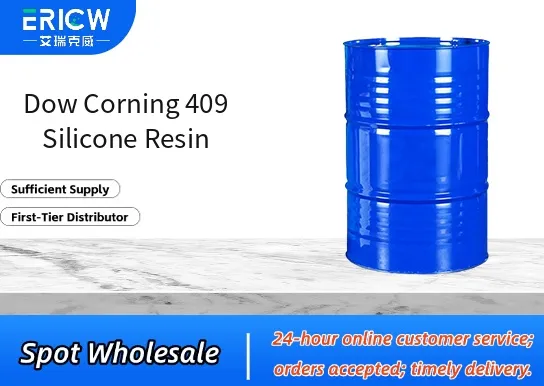
High thermal stability with continuous service capability up to 200 °C.
Excellent electrical insulation properties across wide temperature and frequency ranges.
Good adhesion to metals, glass, and common industrial substrates without priming.
Solvent-based formulation (xylene/toluene blend) enabling easy application via spraying, dipping, or brushing.
Cures at ambient temperature to form a hard, abrasion-resistant, transparent silicone film.
Electrical insulation coating for transformers, inductors, and motor windings.
Protective overcoat for high-temperature nameplates and identification labels.
Dielectric barrier layer in flexible printed circuit assemblies.
Surface treatment for quartz and ceramic components requiring thermal and dielectric integrity.
| Chemical Type | Methyl-phenyl silicone resin |
| Product Form | Liquid solution |
| Appearance | Clear, colorless to pale yellow liquid |
| Solvent System | Xylene/toluene blend |
| Solids Content | 50 ± 2 wt% |
| Viscosity (25 °C, Brookfield RV, #3 spindle, 20 rpm) | 1,200–1,800 cP |
| Density (25 °C) | 0.89–0.91 g/cm³ |
| VOC Content | Approx. 490 g/L |
Q1: What is the primary function of Dow Corning® 409 Silicone Resin in coating formulations?
A: Dow Corning® 409 Silicone Resin is primarily used as a surface modifier and performance enhancer in high-performance coatings. It improves mar resistance, water repellency, and substrate wetting while maintaining compatibility with organic resin systems such as acrylics, polyurethanes, and alkyds.
Q2: Is Dow Corning® 409 Silicone Resin compatible with waterborne systems?
A: Yes, it can be incorporated into waterborne coatings, typically via pre-dilution in a water-miscible solvent or through high-shear emulsification. Compatibility and stability depend on formulation pH, surfactant selection, and processing conditions—lab-scale evaluation is recommended before full-scale implementation.
Q3: How does Dow Corning® 409 Silicone Resin differ from silicone oils or fluid-based additives?
A: Unlike linear silicone fluids, Dow Corning® 409 is a branched, reactive silicone resin with higher molecular weight and silanol functionality. This structure enables covalent integration into crosslinked networks during cure, offering more durable surface effects and reduced migration compared to non-reactive silicone oils.
Q4: What is the typical dosage range for Dow Corning® 409 Silicone Resin in finished coatings?
A: It is generally used at low concentrations—typically ranging from 0.1% to 2% by weight of the total formulation—depending on the desired balance of surface performance, clarity, and intercoat adhesion. Optimal levels should be determined empirically for each specific system.
Contact With Us:
E-mail: wangxingqiang@ericwchem.com
Have a Questions? Call Us:
Add:
Building A1, Jiete Industrial Park, Huangpu District, Guangzhou City, Guangdong Province, China