English
 Español
 tiếng việt
 русский
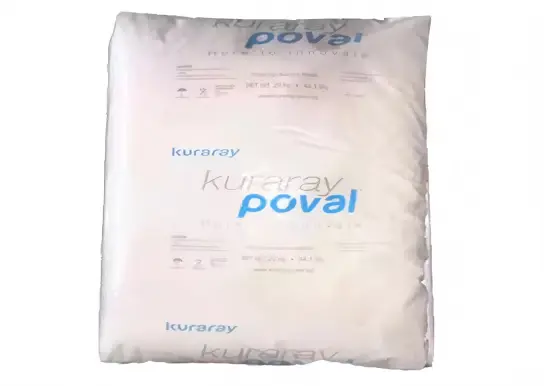
This Kuraray Polyvinyl alcohol PVA series combines controlled hydrolysis technology with tailored molecular architectures. Engineered for high-purity applications, the formulations balance aqueous solubility with mechanical integrity through optimized chain configurations, achieving durable film formation and substrate adhesion without compromising process efficiency.
The series excels in environments requiring simultaneous material cohesion and controlled dissolution. Its oil-resistant backbone ensures stable performance in chemical-intensive applications like PVC dispersion stabilization, while the thermally stable structure (up to 180°C processing) supports high-temperature coating operations. The low-foam variants minimize bubble formation during high-shear mixing, enhancing production continuity in adhesive manufacturing and textile sizing processes.
Optimized Solubility: Partially hydrolyzed structure ensures balanced water solubility and film integrity
Versatile Viscosity: Medium viscosity range enables smooth application in various formulations
Enhanced Chemical Resistance: Provides excellent resistance to oils, chemicals and harsh environments
Strong Adhesion: Bonds effectively to porous substrates while maintaining film clarity
Adhesive Systems: Used in construction adhesives and bonding applications requiring foam reduction
Paper Coatings: Improves surface quality and printability in paper finishing processes
Textile Processing: Enhances fiber treatment in sizing and dyeing applications
Specialty Films: Suitable for water-soluble packaging and controlled-release films
| Model | Degree of Saponification (Hydrolysis) | Volatile Matter | pH (10% Solution) | Viscosity (4% Aqueous, 20°C) |
| PVA 205 | 88 ± 0.5 mol% | ≤5.0% | 5.0–7.0 | 21–25 mPa·s |
| PVA217 | 88 ± 0.5 mol% | ≤5.0% | 5.0–7.0 | 21–25 mPa·s |
| PVA224 | 88 ± 0.5 mol% | ≤5.0% | 5.0–7.0 | 21–25 mPa·s |
| PVA505 | 88 ± 0.5 mol% | ≤5.0% | 5.0–7.0 | 21–25 mPa·s |
| PVA 205S | 88 ± 0.5 mol% | ≤5.0% | 5.0–7.0 | 21–25 mPa·s |
| PVA 205MB | 88 ± 0.5 mol% | ≤5.0% | 5.0–7.0 | 21–25 mPa·s |
| PVA420H | 87.0–89.0 mol% | ≤5.0% | 5.0–7.0 | 20–24 mPa·s |
| PVA KL318 | 88 ± 0.5 mol% | ≤5.0% | 5.0–7.0 | 21–25 mPa·s |
| PVA235 | 87.0–89.0 mol% | ≤5.0% | 5.0–7.0 | 20–24 mPa·s |
| PVA224 (2nd entry) | 87.0–89.0 mol% | ≤5.0% | 5.0–7.0 | 20.5–24.5 mPa·s |
Q1: What is the primary functional role of this PVA grade in industrial formulations?
A: This Kuraray PVA grade functions primarily as a water-soluble binder, film former, and rheology modifier—commonly used in ceramic green body processing, water-based adhesives, and controlled-release matrix systems where cohesive strength and dissolution profile are critical.
Q2: How does its hydrolysis degree and molecular weight influence solubility and film properties?
A: As a partially hydrolyzed, medium-molecular-weight PVA, it offers balanced cold-water dispersibility and hot-water solubility, with film-forming capability that provides good tensile strength and moderate flexibility—ideal for applications requiring both handling integrity and subsequent aqueous removal.
Q3: Is this grade suitable for use in food-contact or pharmaceutical-related processing aids?
A: While not certified for direct food contact or active pharmaceutical ingredient use, this grade is commonly employed as a processing aid in non-leaching, non-residual roles—such as temporary binders in tablet granulation or ceramic tape casting—where full removal during downstream thermal treatment is expected.
Q4: What are typical handling and storage recommendations to maintain performance consistency?
A: Store in a cool, dry environment away from direct sunlight and moisture sources; keep containers tightly sealed to prevent hygroscopic absorption. Pre-dissolution requires gradual dispersion under gentle agitation to avoid surface gelation—avoid high-shear mixing before full wetting.
Contact With Us:
E-mail: wangxingqiang@ericwchem.com
Have a Questions? Call Us:
Add:
Building A1, Jiete Industrial Park, Huangpu District, Guangzhou City, Guangdong Province, China