English
 Español
 tiếng việt
 русский
High thermal stability up to 250 °C continuous use temperature.
Excellent electrical insulation properties with low dielectric loss.
Good compatibility with organic resins and fillers for hybrid formulation design.
Low surface energy enabling superior release performance and anti-adhesion behavior.
Hydrophobic and moisture-resistant, maintaining integrity in humid environments.
High-performance insulating coatings for electric motors and transformers.
Thermal management materials in power electronics and LED packaging.
Release layers in composite manufacturing and silicone rubber molding.
Heat-resistant binders for ceramic and metal oxide coatings.
Key component in high-temperature adhesives and encapsulants.
| Chemical Type | Phenyl-methyl silicone resin |
| Product Form | Clear to slightly hazy liquid |
| Appearance | Colorless to pale yellow, low-viscosity liquid |
| Primary Applications | Electrical insulation, thermal protection, release coatings |
| Key Features | Thermally stable, electrically insulating, hydrophobic |
| Benefits | Enables thin-film application, enhances long-term reliability at elevated temperatures |
| Solvent System | Toluene/xylene blend (typical) |
| Storage Stability | 12 months at 5–30 °C in sealed container |
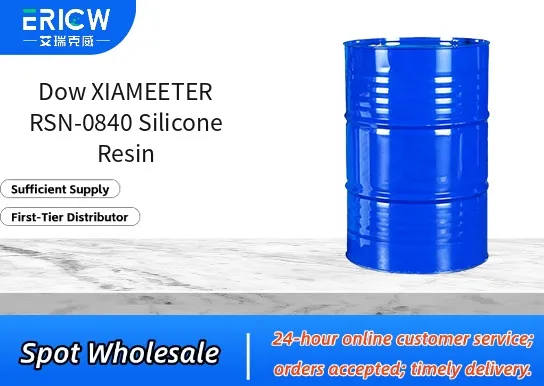
Q1: What is the primary function of Dow XIAMEETER RSN-0840 in coating formulations?
A: Dow XIAMEETER RSN-0840 is a methyl-phenyl silicone resin designed to enhance thermal stability, improve surface hardness, and increase resistance to weathering and chemical exposure in high-performance coatings—particularly for industrial, automotive refinish, and specialty protective applications.
Q2: Is RSN-0840 compatible with organic resin systems such as acrylics or polyesters?
A: Yes, RSN-0840 exhibits good compatibility with many thermosetting organic resins—including acrylic, polyester, and alkyd systems—enabling hybrid formulations that balance silicone performance benefits with cost-effective film formation and substrate adhesion.
Q3: How is RSN-0840 typically incorporated into a formulation?
A: It is generally added during the let-down or post-additive stage under moderate agitation. Due to its solvent-borne nature, it integrates readily into aromatic or ketone-based solvent systems; pre-dilution may be recommended for optimal dispersion in low-solvent or high-solids formulations.
Q4: Does RSN-0840 require thermal curing to develop full performance?
A: While it contributes initial film integrity at ambient conditions, optimal thermal stability, hardness, and crosslink density are achieved through forced-air or oven curing—typically within the range of 120–180 °C, depending on the co-resin system and desired end-use properties.
Contact With Us:
E-mail: wangxingqiang@ericwchem.com
Have a Questions? Call Us:
Add:
Building A1, Jiete Industrial Park, Huangpu District, Guangzhou City, Guangdong Province, China