English
 Español
 tiếng việt
 русский
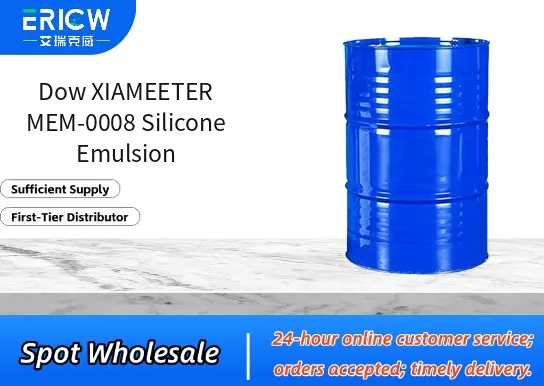
Highly stable anionic silicone emulsion with excellent shelf life under standard storage conditions.
Provides superior lubricity and surface slip for improved processing in aqueous systems.
Offers good compatibility with common water-based polymers, surfactants, and electrolytes.
Delivers consistent softening and anti-static performance on textile and nonwoven substrates.
Low foaming profile suitable for high-shear industrial coating and finishing operations.
Textile fabric softening and handle enhancement in garment and home textile finishing.
Nonwoven web treatment for hygiene products including wipes, diapers, and medical gowns.
Leather finishing to improve suppleness, grain definition, and water repellency.
Coating additives for paper and board to enhance surface smoothness and ink receptivity.
Component in water-based personal care formulations requiring mild conditioning and spreadability.
| Chemical Type | Dimethyl silicone polymer emulsion (anionic) |
| Product Form | Opaque white liquid |
| Appearance | Homogeneous, low-viscosity emulsion |
| pH (1% aqueous solution) | 6.0 – 7.5 |
| Solids Content (wt%) | 30.0 ± 1.0 |
| Density (25°C, g/cm³) | 0.98 – 1.02 |
| Particle Size (D50, nm) | 150 – 250 |
| Freeze-Thaw Stability | Passes 3 cycles (–5°C / 25°C) |
Q1: What is the primary function of Dow XIAMEETER MEM-0008 in formulations?
A: Dow XIAMEETER MEM-0008 is a stable anionic silicone emulsion designed to provide surface softening, lubricity, and hydrophobicity in aqueous systems—commonly used in textile finishing, personal care emulsions, and industrial coatings.
Q2: Is MEM-0008 compatible with cationic or highly acidic systems?
A: As an anionic emulsion, MEM-0008 may experience destabilization when mixed directly with strong cationic agents or at very low pH (< 4.0). Compatibility should be verified experimentally in the final formulation matrix, and appropriate addition sequence or buffering may be required.
Q3: How should MEM-0008 be incorporated into water-based formulations?
A: It is recommended to add MEM-0008 under gentle agitation to the aqueous phase at ambient to moderate temperatures (typically 20–40 °C), avoiding high-shear mixing that could break the emulsion. Pre-dilution with water may aid uniform dispersion in viscous systems.
Q4: Does MEM-0008 require post-application curing or heat treatment to develop full performance?
A: No thermal cure is strictly required for film formation or surface effects; functionality develops upon water evaporation during drying. However, mild thermal treatment (e.g., 80–120 °C for several minutes) can enhance film coalescence and durability in certain textile or coating applications.
Contact With Us:
E-mail: wangxingqiang@ericwchem.com
Have a Questions? Call Us:
Add:
Building A1, Jiete Industrial Park, Huangpu District, Guangzhou City, Guangdong Province, China