English
 Español
 tiếng việt
 русский
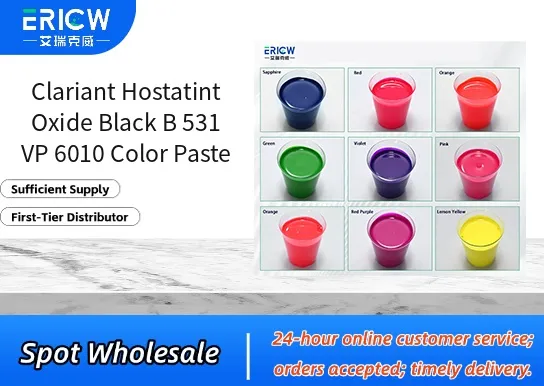
Highly concentrated iron oxide-based black pigment dispersion for excellent color strength and opacity.
Optimized rheology for easy incorporation into water-based and solvent-based systems without regrinding.
Excellent lightfastness and weather resistance, meeting stringent outdoor durability requirements.
Low volatile organic compound (VOC) content, supporting compliance with global environmental regulations.
Stable storage performance with minimal sedimentation over 12 months under recommended conditions.
Architectural and industrial waterborne coatings.
Automotive refinish and OEM basecoat/clearcoat systems.
Plastic coloration for PP, PE, ABS, and PVC compounds.
Printing inks for packaging and label applications.
Construction materials including cementitious renders and tile adhesives.
| Chemical Type | Iron oxide (Fe₃O₄) pigment dispersion |
| Product Form | Liquid color paste |
| Appearance | Viscous black paste, homogeneous and free of grit |
| Primary Applications | Coatings, plastics, inks, construction materials |
| Key Features | High tinctorial strength, low VOC, shear-stable dispersion |
| Recommended Carrier | Water and glycol-based vehicles; compatible with common co-solvents |
| Storage Stability | ≥12 months at 5–30 °C in sealed original container |
| Heavy Metals Content | Compliant with EN 71-3 and ASTM F963 (low lead, cadmium, mercury) |
Q1: What is the primary application field for Hostatint Oxide Black B 531 VP 6010?
A: This pigment paste is specifically developed for coloring polyolefin compounds—especially polypropylene (PP) and polyethylene (PE)—in applications requiring high thermal stability, excellent dispersion, and consistent jetness in injection molding, blow molding, and extrusion processes.
Q2: Is this color paste suitable for food-contact or medical-grade polyolefins?
A: Hostatint Oxide Black B 531 VP 6010 is formulated to meet stringent regulatory expectations for indirect food contact applications where permitted by local legislation. It contains no intentionally added heavy metals or restricted azo dyes, and its use in medical-grade polymers should be validated per end-product requirements and applicable biocompatibility standards.
Q3: How does this paste compare to dry pigment powders in terms of processing performance?
A: As a pre-dispersed liquid paste, it offers superior handling safety, reduced dust generation, more consistent dosing, and faster incorporation into molten polymer matrices—resulting in shorter mixing times, improved color uniformity, and lower risk of agglomerates compared to dry pigments.
Q4: What carrier system is used in this paste, and how does it affect compatibility?
A: The paste uses a non-volatile, polyolefin-compatible carrier system designed to minimize interference with polymer rheology and mechanical properties. It demonstrates broad compatibility across homopolymer and copolymer grades of PP and PE, including impact-modified and filled formulations.
Q5: What is the typical dosage range when using this paste in polyolefin masterbatches?
A: Dosage depends on the desired shade depth and base polymer, but it is typically used at low concentrations—generally ranging from 0.1% to 2% by weight in final parts—allowing efficient coloration without compromising processing or end-use performance.
Contact With Us:
E-mail: wangxingqiang@ericwchem.com
Have a Questions? Call Us:
Add:
Building A1, Jiete Industrial Park, Huangpu District, Guangzhou City, Guangdong Province, China