English
 Español
 tiếng việt
 русский
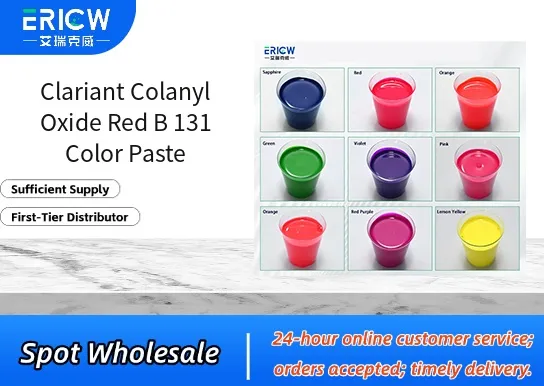
High chroma, intense oxide red shade with excellent color strength and batch-to-batch consistency.
Optimized for outstanding dispersion stability in water-based systems without flocculation or settling.
Low volatile organic compound (VOC) content, supporting compliance with stringent environmental and regulatory standards.
Good lightfastness and thermal stability up to 180 °C, suitable for medium-temperature processing.
Compatible with common acrylic, styrene-acrylic, and PVA-based binders used in architectural and industrial coatings.
Architectural interior and exterior wall paints.
Industrial maintenance coatings for metal substrates.
Water-based wood stains and varnishes.
Construction mortars and decorative concrete finishes.
General-purpose waterborne primers and undercoats.
| Chemical Type | Inorganic iron oxide pigment dispersion |
| Product Form | Concentrated aqueous color paste |
| Appearance | Uniform, viscous red paste with slight gloss |
| Primary Applications | Water-based architectural and industrial coatings |
| Key Features | High tinting strength, low VOC, excellent wetting & dispersion |
| Benefits | Reduced formulation complexity, improved color reproducibility, enhanced storage stability |
| pH (10% aqueous dilution) | 7.5 – 8.5 |
| Specific Gravity (20 °C) | 1.45 – 1.55 g/cm³ |
Q1: What types of polymer systems is Colanyl Oxide Red B 131 Color Paste compatible with?
A: This color paste is specifically formulated for use in polyolefin-based systems, including polypropylene (PP) and polyethylene (PE), and demonstrates good compatibility in thermoplastic elastomers (TPEs) and certain engineering plastics. Performance in polar polymers or highly reactive matrices may require preliminary compatibility testing.
Q2: How should Colanyl Oxide Red B 131 be incorporated into a polymer melt process?
A: It is typically introduced via side-feeding or gravimetric dosing directly into the extruder barrel, or pre-blended with base resin using high-shear mixing. Good dispersion is achieved under standard melt processing conditions; extended residence time or excessive shear is not required.
Q3: Does this color paste contain heavy metals or halogenated compounds?
A: Colanyl Oxide Red B 131 is formulated without intentionally added heavy metals (e.g., lead, cadmium, mercury, hexavalent chromium) or halogenated organic carriers. Its composition aligns with common regulatory expectations for colorants used in general-purpose industrial and consumer applications.
Q4: What is the typical dosage range for achieving target shade intensity?
A: Dosage depends on the polymer matrix, desired opacity, and shade depth, but it is generally used at low concentrations—typically ranging from 0.1% to 2% by weight relative to the base resin. Optimal loading should be determined through small-scale trials to balance color strength, dispersion quality, and mechanical properties.
Q5: Is Colanyl Oxide Red B 131 suitable for applications requiring thermal stability during processing?
A: Yes, it is designed for stability under standard polyolefin processing temperatures (up to approximately 260 °C), with minimal risk of color shift or degradation when processed within recommended time–temperature windows. Extended exposure above 280 °C may affect performance and is not recommended.
Contact With Us:
E-mail: wangxingqiang@ericwchem.com
Have a Questions? Call Us:
Add:
Building A1, Jiete Industrial Park, Huangpu District, Guangzhou City, Guangdong Province, China