English
 Español
 tiếng việt
 русский
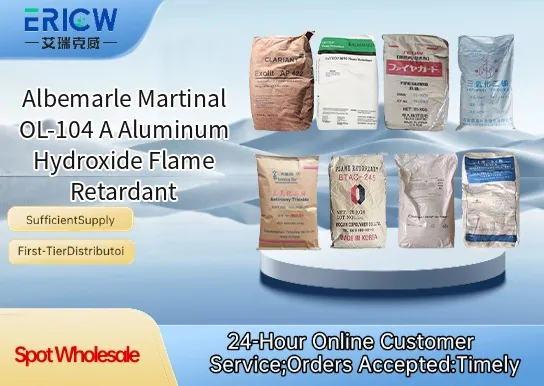
High-purity, surface-treated aluminum hydroxide offering excellent flame retardancy and smoke suppression.
Optimized particle size distribution for improved dispersion and compatibility in polymer matrices.
Low abrasivity to processing equipment, enhancing screw and barrel life during compounding.
Thermally stable up to ~200 °C, supporting processing of engineering thermoplastics without premature decomposition.
Halogen-free formulation, contributing to low toxicity and compliance with RoHS, REACH, and UL 94 standards.
Flame-retarded polypropylene (PP) for automotive interior components.
Wire and cable jacketing compounds based on low-smoke zero-halogen (LSZH) thermosets and thermoplastics.
Flame-retardant rigid PVC profiles for building and construction applications.
Engineering thermoplastics including polyethylene (PE) and ethylene-propylene rubber (EPR) used in electrical enclosures.
Fire-safe elastomeric compounds for gaskets, seals, and transit interior materials.
| Chemical Type | Aluminum hydroxide, Al(OH)₃ |
| Product Form | Fine white powder |
| Appearance | White, free-flowing powder |
| Primary Applications | Halogen-free flame retardant for polymers and elastomers |
| Key Features | Surface-treated, low abrasivity, high thermal stability |
| Benefits | Reduces flame spread, suppresses smoke and toxic gas emission |
| Decomposition Onset Temperature | ≈180–200 °C (TGA, 10 °C/min, air) |
| Moisture Content (max) | 0.5 wt% |
Q1: What is the primary mechanism by which Martinal OL-104 A provides flame retardancy?
A: Martinal OL-104 A functions primarily through endothermic decomposition—releasing water vapor upon heating—which cools the substrate and dilutes flammable gases. Its aluminum hydroxide chemistry also promotes char formation in many polymer systems, contributing to reduced heat release and flame spread.
Q2: Is Martinal OL-104 A suitable for use in halogen-free cable jacketing compounds?
A: Yes—Martinal OL-104 A is widely selected for halogen-free low-smoke zero-halogen (LSZH) cable compounds due to its high purity, consistent particle morphology, and compatibility with common thermoplastic elastomers and cross-linked polyolefins used in such applications.
Q3: How does surface treatment affect processing and final properties in compounded systems?
A: Martinal OL-104 A features a proprietary surface treatment optimized for improved dispersion in non-polar polymers and enhanced interfacial adhesion. This typically results in better melt flow during extrusion, reduced torque, and improved mechanical retention—especially tensile strength and impact resistance—at typical loading levels.
Q4: Can OL-104 A be used in thermoset composites such as unsaturated polyester or vinyl ester resins?
A: Yes—OL-104 A is compatible with several thermoset systems, including unsaturated polyesters and vinyl esters. Its fine particle size and surface chemistry support good suspension in resin pastes and contribute to improved fire performance without significantly compromising gel time or cure profile under standard processing conditions.
Contact With Us:
E-mail: wangxingqiang@ericwchem.com
Have a Questions? Call Us:
Add:
Building A1, Jiete Industrial Park, Huangpu District, Guangzhou City, Guangdong Province, China