English
 Español
 tiếng việt
 русский
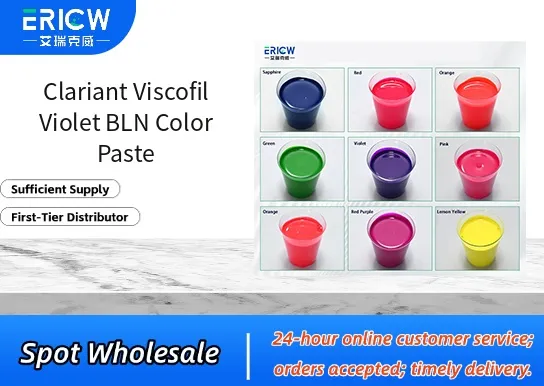
High chroma violet shade with excellent batch-to-batch color consistency.
Optimized rheology for smooth incorporation into water-based and solvent-based systems.
Good lightfastness and thermal stability suitable for medium-temperature processing.
Low migration tendency in polymer matrices, enhancing color retention in end products.
Compliant with major global regulatory frameworks for industrial applications (e.g., REACH, RoHS).
Water-based architectural coatings and decorative paints.
Solvent-based industrial maintenance coatings.
Plastic coloration for ABS, PS, and PVC compounds.
Ink formulations for packaging gravure and flexographic printing.
Wood stains and clear finishes requiring transparent violet tinting.
| Chemical Type | Organic pigment dispersion (Violet 23-based) |
| Product Form | Concentrated liquid color paste |
| Appearance | Viscous, homogeneous violet paste |
| Primary Applications | Coatings, plastics, inks |
| Key Features | High dispersibility, low dusting, easy dosage |
| Benefits | Reduced mixing time, improved color strength, minimal filter clogging |
| VOC Content | Low-VOC formulation (< 50 g/L) |
| Storage Stability | 12 months at 5–30 °C in sealed original container |
Q1: What is the primary application field for Viscofil Violet BLN Color Paste?
A: Viscofil Violet BLN is specifically developed for coloring polyolefin-based packaging materials, including flexible films, blow-molded containers, and injection-molded closures—particularly where high transparency, excellent dispersion, and thermal stability during processing are required.
Q2: Is this color paste suitable for food-contact applications?
A: Yes, Viscofil Violet BLN is formulated to comply with global food-contact regulations for polyolefins, subject to final regulatory assessment in the target market and adherence to good manufacturing practices. Users must verify compliance with applicable local requirements before commercial use.
Q3: How should Viscofil Violet BLN be incorporated into polyolefin compounds?
A: It is typically added directly to the polymer melt during extrusion or injection molding using standard gravimetric or volumetric dosing systems. Pre-blending with carrier resin is not required, but thorough mixing ensures optimal dispersion and color uniformity.
Q4: What is the recommended dosage range for achieving consistent violet shades?
A: Dosage depends on the desired shade intensity and base polymer characteristics, but it is generally used at low concentrations—typically ranging from 0.1% to 2% by weight relative to the polymer matrix.
Q5: Does Viscofil Violet BLN offer resistance to migration and blooming in thin-film applications?
A: Yes, the paste is engineered for strong pigment-polymer compatibility and demonstrates low tendency toward migration or surface blooming under standard storage and processing conditions—especially in PP and PE films processed at typical temperatures.
Contact With Us:
E-mail: wangxingqiang@ericwchem.com
Have a Questions? Call Us:
Add:
Building A1, Jiete Industrial Park, Huangpu District, Guangzhou City, Guangdong Province, China