English
 Español
 tiếng việt
 русский
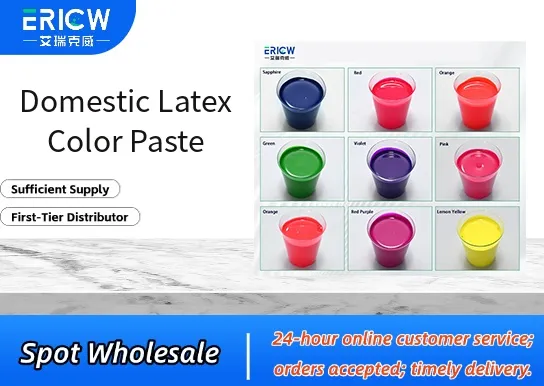
High chroma and excellent color consistency across batches.
Optimized for compatibility with water-based acrylic and vinyl acetate latex systems.
Low VOC formulation compliant with GB/T 23999–2009 and EU EN 71-3 safety standards.
Stable dispersion without sedimentation or flocculation during 12-month shelf life (unopened, stored at 5–35°C).
Easy dispersion with minimal shear—no pre-mixing or high-speed disperser required.
Interior wall paints for residential and commercial buildings.
Architectural coatings including textured finishes and decorative plasters.
Water-based wood primers and clear topcoats requiring color stability.
DIY paint kits and ready-to-use tinted emulsion paints.
Non-woven wallpaper coatings and textile printing pastes.
| Chemical Type | Aqueous pigment dispersion based on organic & inorganic pigments |
| Product Form | Liquid paste, non-settling suspension |
| Appearance | Homogeneous viscous liquid; color-specific hue and opacity |
| pH Value (25°C) | 7.5–8.5 |
| Viscosity (Brookfield LVT, #3 spindle, 6 rpm) | 8,000–15,000 cP |
| Heavy Metals (Pb, Cd, Hg, Cr⁶⁺) | Below detection limit per GB 18582–2020 |
| Storage Stability | 12 months at 5–35°C, unopened container |
| Freeze-Thaw Resistance | Withstands 5 cycles (−5°C × 16 h / 23°C × 8 h) without separation |
Q1: What is Domestic Latex Color Paste used for?
A: It is a concentrated pigment dispersion formulated specifically for tinting water-based interior architectural coatings, such as flat, eggshell, and satin latex paints, enabling consistent color matching and excellent compatibility with common acrylic and vinyl-acrylic latex binders.
Q2: Is this product compatible with zero-VOC or low-VOC paint systems?
A: Yes — Domestic Latex Color Paste is designed without aromatic hydrocarbons or heavy-metal pigments, and its base formulation supports compliance with typical zero-VOC and low-VOC architectural coating requirements when used within recommended dosage ranges.
Q3: How should the color paste be incorporated into paint formulations?
A: It is typically added during the let-down stage under moderate agitation. Good dispersion is achieved without high-shear mixing, and it remains stable in the final formulation without settling or flocculation when properly balanced with common thickeners and surfactants.
Q4: Does this color paste affect the freeze-thaw stability of latex paints?
A: When used at typical dosage levels, it does not negatively impact freeze-thaw resistance. However, excessive addition may influence binder-pigment interactions, so formulation testing under standard freeze-thaw cycles is recommended for critical applications.
Contact With Us:
E-mail: wangxingqiang@ericwchem.com
Have a Questions? Call Us:
Add:
Building A1, Jiete Industrial Park, Huangpu District, Guangzhou City, Guangdong Province, China