English
 Español
 tiếng việt
 русский
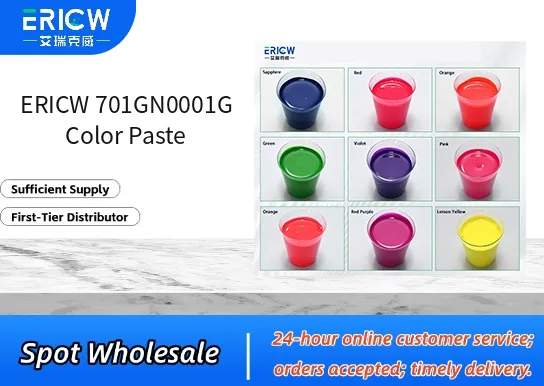
High chroma green pigment dispersion with excellent color strength and batch-to-batch consistency.
Optimized for compatibility with water-based acrylic, polyurethane, and epoxy resin systems.
Low volatile organic compound (VOC) formulation meeting global environmental compliance standards.
Thixotropic rheology ensures stable suspension and minimizes settling during storage.
Non-hazardous classification per GHS; no heavy metals (lead, cadmium, mercury, or hexavalent chromium) detected.
Architectural coatings including interior/exterior wall paints and primers.
Industrial maintenance coatings for metal structures and equipment.
Water-based wood stains and clear finishes requiring vibrant, lightfast green tones.
Plastic coloration for ABS, PVC, and PP compounds in non-food-contact applications.
Printing inks for packaging films and labels where regulatory compliance is critical.
| Chemical Type | Organic pigment dispersion (phthalocyanine-based) |
| Product Form | Viscous liquid paste |
| Appearance | Uniform green paste, free of lumps and visible particles |
| Primary Applications | Water-based and solvent-free coating systems |
| Key Features | Good dispersibility, high tinting strength, UV resistance |
| Benefits | Reduced grinding time, improved color development, low dosage requirement |
| pH (10% aqueous dilution) | 7.5 – 8.5 |
| Storage Stability | 12 months at 5–30°C in sealed container |
Q1: What is the primary application field for ERICW 701GN0001G Color Paste?
A: ERICW 701GN0001G is specifically formulated for coloring polyolefin-based compounds, including PP and HDPE, commonly used in injection-molded and extruded industrial and consumer goods where consistent green hue and thermal stability are required.
Q2: Is this color paste suitable for food-contact applications?
A: ERICW 701GN0001G is designed with non-migrating pigments and carrier resins compatible with food-contact polymer systems; however, final regulatory compliance depends on the complete formulation, processing conditions, and applicable regional requirements—users must conduct full migration and safety assessments as part of their qualification process.
Q3: How should ERICW 701GN0001G be incorporated into base polymers?
A: It is typically introduced via gravimetric or volumetric dosing directly into the extruder feed throat or compounder; pre-blending with a portion of the base resin may improve dispersion. Optimal incorporation occurs at temperatures below the degradation threshold of the carrier system, generally during standard polyolefin processing windows.
Q4: What is the recommended dosage range?
A: Dosage depends on the desired shade intensity and base polymer opacity, but it is typically used at low concentrations—generally ranging from 0.1% to 2% by weight relative to the total compound.
Contact With Us:
E-mail: wangxingqiang@ericwchem.com
Have a Questions? Call Us:
Add:
Building A1, Jiete Industrial Park, Huangpu District, Guangzhou City, Guangdong Province, China