English
 Español
 tiếng việt
 русский
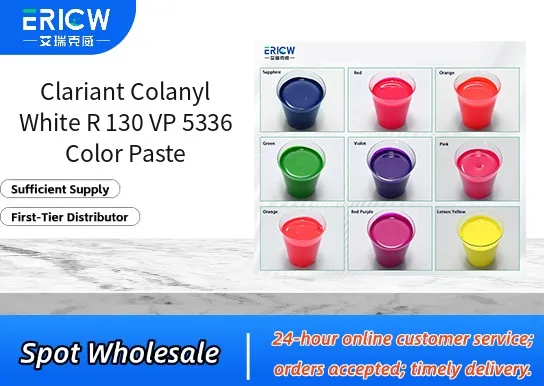
High-opacity titanium dioxide-based white pigment dispersion for excellent hiding power.
Optimized rheology for easy incorporation into water-based and solvent-based systems without regrinding.
Excellent lightfastness and thermal stability up to 180 °C, suitable for demanding processing conditions.
Low volatile organic compound (VOC) content, supporting compliance with stringent environmental regulations.
Consistent batch-to-batch color strength and dispersion quality, ensuring manufacturing reproducibility.
Architectural and industrial waterborne coatings.
Plastic coloration for polyolefins and PVC compounds.
Inks for flexible packaging and gravure printing.
Wood coatings requiring high whiteness and scrub resistance.
Adhesives and sealants where neutral tone and opacity are critical.
| Chemical Type | Titanium dioxide (rutile) pigment dispersion |
| Product Form | Paste (liquid dispersion) |
| Appearance | Opaque white paste, homogeneous and free of grit |
| Primary Applications | Coatings, plastics, inks, adhesives |
| Key Features | High opacity, low VOC, thermally stable, ready-to-use |
| Recommended Carrier System | Water and selected glycol ethers or aromatic solvents |
| Storage Stability | 12 months at 5–30 °C in sealed original container |
| Specific Gravity (20 °C) | Approx. 1.45–1.55 g/cm³ |
Q1: What is the primary application field for Colanyl White R 130 VP 5336?
A: This color paste is specifically developed for coloring polyolefin compounds, particularly in injection molding and extrusion applications where high thermal stability, excellent dispersion, and consistent whiteness are required.
Q2: Is this product suitable for food-contact polyolefin applications?
A: Colanyl White R 130 VP 5336 is formulated with pigments and additives intended for use in food-contact plastics, subject to compliance with applicable regional regulations. Users must verify final formulation compliance based on their specific processing conditions and regulatory jurisdiction.
Q3: How should this color paste be incorporated into polyolefin resins?
A: It is typically added directly to the base polymer using standard compounding equipment such as twin-screw extruders or high-intensity mixers. Good dispersion is achieved under typical melt processing conditions; pre-drying is not required.
Q4: What is the recommended dosage range for achieving full opacity in PP or HDPE?
A: Dosage depends on the base resin, desired opacity level, and processing parameters, but it is generally used at low concentrations—typically ranging from 0.1% to 2% by weight—to achieve effective whitening and hiding power.
Q5: Does this color paste contain heavy metals or restricted substances?
A: Colanyl White R 130 VP 5336 is manufactured without intentionally added lead, cadmium, mercury, or hexavalent chromium, in alignment with Clariant’s commitment to responsible chemistry and common industry restrictions such as RoHS and REACH SVHC guidelines.
Contact With Us:
E-mail: wangxingqiang@ericwchem.com
Have a Questions? Call Us:
Add:
Building A1, Jiete Industrial Park, Huangpu District, Guangzhou City, Guangdong Province, China