English
 Español
 tiếng việt
 русский
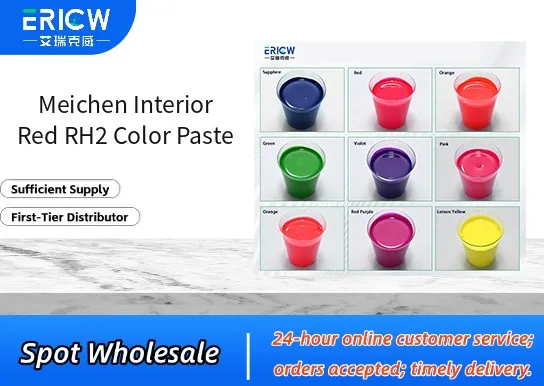
High chroma, lightfast red pigment dispersion optimized for interior architectural coatings.
Excellent compatibility with water-based acrylic, vinyl, and styrene-acrylic emulsion systems.
Low VOC formulation compliant with global interior paint regulatory requirements.
Stable rheology and minimal settling during storage—no regrinding required before use.
Precise batch-to-batch color consistency ensured by ISO 9001-certified manufacturing.
Interior wall paints for residential and commercial buildings.
Architectural primers requiring high hiding power and clean red tone.
Low-odor decorative finishes in schools, hospitals, and elderly care facilities.
Water-based interior wood stains and clear topcoats for accent surfaces.
Custom-tinted plaster, skim coat, and textured wall coatings.
| Chemical Type | Organic pigment dispersion (C.I. Pigment Red 112 based) |
| Product Form | Liquid color paste, aqueous medium |
| Appearance | Homogeneous, viscous red liquid with slight gloss |
| Primary Applications | Interior water-based architectural coatings |
| Key Features | Non-bleeding, non-floating, low foaming |
| Benefits | Reduced tinting time, improved color development, enhanced scrub resistance |
| pH Value (25°C) | 7.8–8.4 |
| Storage Stability | 12 months at 5–30°C in sealed original container |
Q1: What types of interior coatings is Meichen Interior Red RH2 Color Paste designed for?
A: This color paste is specifically formulated for waterborne and solvent-based interior architectural coatings, including emulsion paints, interior wall primers, and low-VOC decorative finishes. It delivers excellent dispersion stability and color consistency in alkaline paint systems.
Q2: How does RH2 perform under standard interior exposure conditions, such as light and humidity?
A: Meichen Interior Red RH2 exhibits good lightfastness and humidity resistance typical of high-performance organic red pigments used in interior applications. It maintains color integrity under normal indoor lighting and ambient humidity levels but is not recommended for direct exterior or UV-intensive environments.
Q3: Is RH2 compatible with common co-binders and additives used in interior paint formulations?
A: Yes — RH2 is compatible with acrylic, vinyl acetate, and styrene-acrylic co-binders, as well as standard dispersants, defoamers, and rheology modifiers. Compatibility testing under specific formulation conditions is always recommended prior to full-scale integration.
Q4: What is the typical dosage range for achieving medium-to-high red intensity in interior paints?
A: Dosage depends on the base formulation and desired shade strength, but RH2 is typically used at low concentrations — generally ranging from 0.1% to 2% by weight relative to total paint mass — to achieve consistent, reproducible interior red tones.
Contact With Us:
E-mail: wangxingqiang@ericwchem.com
Have a Questions? Call Us:
Add:
Building A1, Jiete Industrial Park, Huangpu District, Guangzhou City, Guangdong Province, China