English
 Español
 tiếng việt
 русский
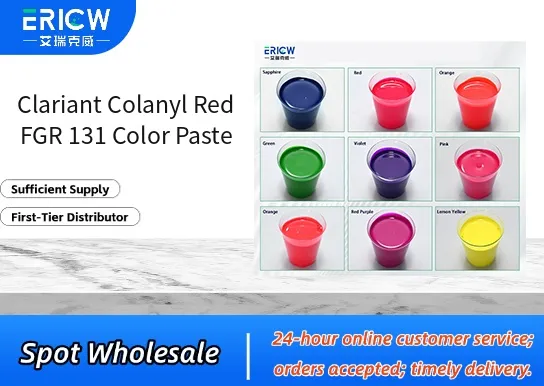
High chroma red shade with excellent color strength and batch-to-batch consistency.
Optimized for compatibility with water-based and solvent-based acrylic, vinyl, and alkyd systems.
Good lightfastness and thermal stability up to 160 °C for short-term processing.
Low volatile organic compound (VOC) content, supporting sustainable formulation requirements.
Easy dispersion with minimal shear, enabling efficient incorporation into base paints and coatings.
Architectural interior and exterior wall paints.
Industrial maintenance coatings for metal and wood substrates.
Automotive refinish primers and basecoats (non-OEM).
Plastic compounding for rigid PVC and ABS applications.
Printing inks for packaging and decorative laminates.
| Chemical Type | Organic pigment dispersion (P.R. 112 based) |
| Product Form | Liquid color paste |
| Appearance | Homogeneous, viscous red liquid with slight gloss |
| Primary Applications | Water-based and solvent-based architectural/industrial coatings, plastic coloration |
| Key Features | High tinting strength, good wetting, low dusting risk |
| Benefits | Reduced formulation time, improved color accuracy, enhanced storage stability |
| pH (10% aqueous dilution) | 7.5 – 8.5 |
| Storage Stability | ≥ 12 months at 5–30 °C in sealed original container |
Q1: What types of polymer systems is Colanyl Red FGR 131 Color Paste compatible with?
A: Colanyl Red FGR 131 is formulated for use in polyolefins—including PP and HDPE—as well as certain engineering thermoplastics. It demonstrates good dispersion stability and thermal resistance during standard melt processing conditions.
Q2: How should this color paste be incorporated into a polymer formulation?
A: It is typically introduced via gravimetric or volumetric dosing directly into the extruder feed throat or hopper, either neat or pre-blended with carrier resin. Good mixing efficiency and residence time are recommended to ensure uniform dispersion.
Q3: Is Colanyl Red FGR 131 suitable for applications requiring food contact compliance?
A: This grade is designed for non-food-contact industrial applications. For food-contact uses, Clariant offers alternative colorants specifically assessed against relevant regional regulatory frameworks—consult your Clariant representative for compliant options.
Q4: What is the typical dosage range for achieving strong red shades in polypropylene?
A: Dosage depends on the desired shade intensity and base polymer opacity, but it is generally used at low concentrations—typically ranging from 0.1% to 2% by weight—due to its high tinting strength and efficient pigment dispersion.
Contact With Us:
E-mail: wangxingqiang@ericwchem.com
Have a Questions? Call Us:
Add:
Building A1, Jiete Industrial Park, Huangpu District, Guangzhou City, Guangdong Province, China