English
 Español
 tiếng việt
 русский
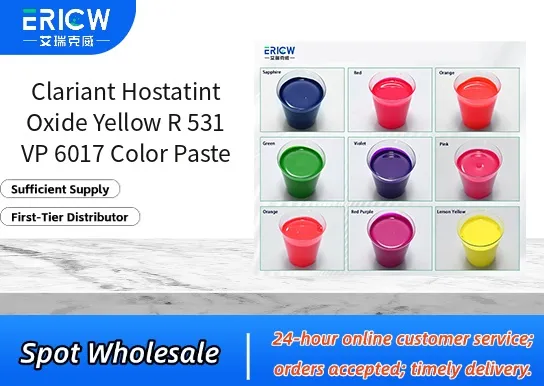
High chroma, lightfast yellow oxide pigment dispersion with excellent color strength and consistency.
Optimized for low viscosity and superior rheological behavior in water-based systems.
Free of heavy metals and compliant with major global regulatory frameworks including REACH and RoHS.
Stable against thermal processing up to 180 °C, suitable for extrusion and injection molding applications.
Engineered for outstanding dispersion stability and minimal sedimentation during long-term storage.
Water-based architectural coatings and interior wall paints.
Plastic coloration for polyolefins (PP, PE) and PVC compounds.
Industrial maintenance coatings and coil coatings.
Printing inks for flexible packaging and label applications.
Masterbatch production for automotive interior components.
| Chemical Type | Iron oxide-based inorganic pigment dispersion |
| Product Form | Liquid color paste (aqueous) |
| Appearance | Homogeneous, viscous yellow paste |
| Primary Applications | Coatings, plastics, inks, masterbatches |
| Key Features | Good dispersibility, high opacity, UV stability |
| Benefits | Reduced dosing, consistent batch-to-batch color, easy handling |
| VOC Content | < 5 g/L (water-based, non-volatile) |
| Storage Stability | 12 months at 5–30 °C in sealed original container |
Q1: What is the primary chemical composition of this color paste?
A: Hostatint Oxide Yellow R 531 VP 6017 is a highly concentrated pigment dispersion based on inorganic iron oxide yellow (CI Pigment Yellow 42), stabilized in a proprietary liquid carrier system designed for compatibility with polar and moderately polar polymer matrices.
Q2: Is this product suitable for use in polyolefin applications such as PP or PE?
A: Yes — it is specifically formulated for good dispersion stability and thermal resistance in polyolefins, including injection molding and extrusion processes. Performance may vary depending on melt temperature, shear history, and base resin characteristics.
Q3: How should this paste be incorporated into polymer compounds?
A: It is typically added directly to the polymer melt during compounding via side-stuffer or gravimetric feeder. Pre-mixing with a portion of the base resin prior to extrusion can improve dispersion uniformity. Avoid prolonged high-shear processing at elevated temperatures beyond recommended limits.
Q4: Does this product comply with food contact regulations?
A: The base pigment (CI Pigment Yellow 42) is permitted under major global food-contact frameworks for specific polymer types and conditions. However, final regulatory compliance depends on full formulation, processing parameters, and end-use application — users must verify suitability with their regulatory team and local authorities.
Contact With Us:
E-mail: wangxingqiang@ericwchem.com
Have a Questions? Call Us:
Add:
Building A1, Jiete Industrial Park, Huangpu District, Guangzhou City, Guangdong Province, China