English
 Español
 tiếng việt
 русский
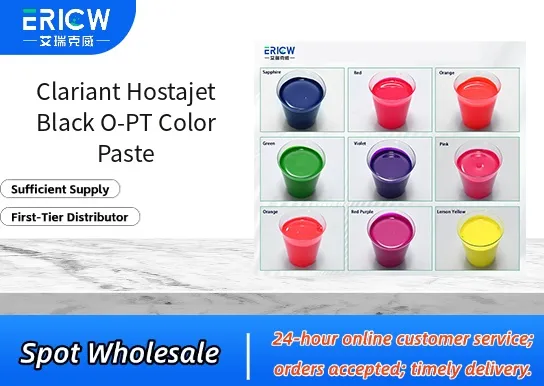
Highly concentrated pigment dispersion optimized for water-based inkjet inks.
Excellent jetting stability and nozzle compatibility in piezoelectric printheads.
Superior lightfastness and thermal stability for demanding digital textile printing.
Low viscosity and excellent storage stability without sedimentation or flocculation.
Compliant with Oeko-Tex® Standard 100 Class I requirements for baby articles.
Digital direct-to-garment (DTG) textile printing on cotton and blends.
Roll-to-roll digital textile printing for fashion and home décor fabrics.
Industrial inkjet applications requiring high-opacity black performance.
Water-based reactive ink formulations for cellulose fibers.
Custom ink manufacturing for OEM digital textile printers.
| Chemical Type | Organic pigment dispersion (Carbon Black-based) |
| Product Form | Liquid color paste, aqueous medium |
| Appearance | Jet-black, homogeneous liquid |
| Primary Applications | Water-based inkjet inks for digital textile printing |
| Key Features | High chroma, low particle size (<200 nm), pH-stabilized |
| Benefits | Reduced printhead maintenance, consistent color reproduction, fast drying |
| Storage Conditions | 5–35 °C; protect from freezing and direct sunlight |
| Shelf Life | 12 months from date of manufacture under recommended conditions |
Q1: What is the primary application of Hostajet Black O-PT Color Paste?
A: Hostajet Black O-PT is specifically formulated for coloring polyolefin-based packaging films and containers, particularly where high jetness, excellent dispersion, and thermal stability during extrusion or injection molding are required.
Q2: Is this paste compatible with food-contact polyolefin applications?
A: Yes — Hostajet Black O-PT is designed for use in food-contact compliant polyolefin systems, subject to final formulation validation and adherence to applicable regional regulatory requirements for indirect food contact.
Q3: How should the paste be incorporated into polyolefin resins?
A: It is typically added directly to the base polymer via gravimetric or volumetric dosing systems prior to extrusion or injection molding. Good mixing efficiency ensures uniform dispersion without agglomeration.
Q4: What is the typical dosage range for achieving target black intensity?
A: Dosage depends on the desired shade depth and substrate thickness, but it is generally used at low concentrations — typically ranging from 0.1% to 2% by weight relative to the base polymer.
Contact With Us:
E-mail: wangxingqiang@ericwchem.com
Have a Questions? Call Us:
Add:
Building A1, Jiete Industrial Park, Huangpu District, Guangzhou City, Guangdong Province, China