English
 Español
 tiếng việt
 русский
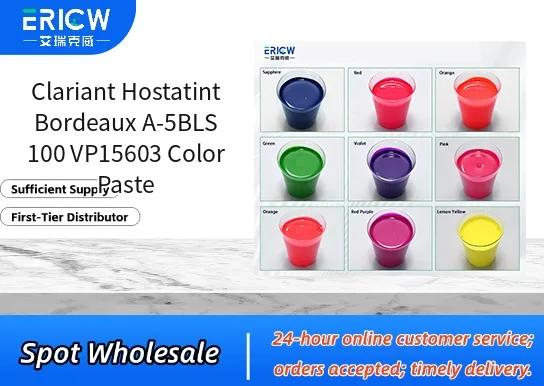
High chroma, intense bordeaux shade with excellent batch-to-batch color consistency.
Optimized for water-based systems including acrylic, vinyl acetate, and styrene-acrylic emulsions.
Excellent dispersion stability and low viscosity for easy incorporation into formulations.
Complies with relevant global regulatory requirements for industrial coatings and construction applications.
Low volatile organic compound (VOC) content supporting sustainable formulation strategies.
Architectural paints and interior/exterior wall coatings.
Cementitious and plaster-based decorative renders.
Water-based wood stains and clear finishes.
Industrial maintenance coatings for metal and masonry substrates.
Tile grouts and colored mortars for construction applications.
| Chemical Type | Organic pigment dispersion (Bordeaux shade) |
| Product Form | Liquid color paste |
| Appearance | Homogeneous, viscous liquid with uniform bordeaux hue |
| Primary Applications | Water-based architectural and construction coatings |
| Key Features | High tinctorial strength, good lightfastness, pH-stable dispersion |
| Benefits | Easy dosing, minimal filter clogging, compatibility with common thickeners |
| Storage Conditions | Store at 5–30 °C; protect from freezing and direct sunlight |
| Shelf Life | 12 months from date of manufacture under recommended conditions |
Q1: What is the primary application field for Hostatint Bordeaux A-5BLS 100 VP15603?
A: This pigment paste is specifically developed for coloring polyolefin-based plastics—especially PP and HDPE—in applications requiring high thermal stability, good dispersion, and consistent shade reproducibility, such as automotive interior parts, consumer packaging, and technical injection-molded components.
Q2: Is this color paste suitable for food-contact plastic applications?
A: Hostatint Bordeaux A-5BLS 100 VP15603 is formulated using pigments and additives compliant with major global food-contact regulations for plastics, subject to final formulation validation. Users must verify compliance in their specific end-use matrix and processing conditions, as regulatory acceptance depends on total formulation, migration behavior, and intended contact type.
Q3: How should this paste be incorporated into polyolefin compounds?
A: It is typically added directly to the polymer melt during extrusion compounding or injection molding. Good dispersion is achieved through standard high-shear mixing; pre-dilution is not required, but dosage should be optimized based on desired color strength and processing parameters.
Q4: What are the key handling and storage recommendations?
A: Store in original sealed containers at temperatures between 5 °C and 30 °C, away from direct sunlight and sources of heat. Avoid freezing. Stir gently before use if sedimentation occurs after prolonged storage. Ensure compatibility testing with other additives in multi-component formulations.
Contact With Us:
E-mail: wangxingqiang@ericwchem.com
Have a Questions? Call Us:
Add:
Building A1, Jiete Industrial Park, Huangpu District, Guangzhou City, Guangdong Province, China