English
 Español
 tiếng việt
 русский
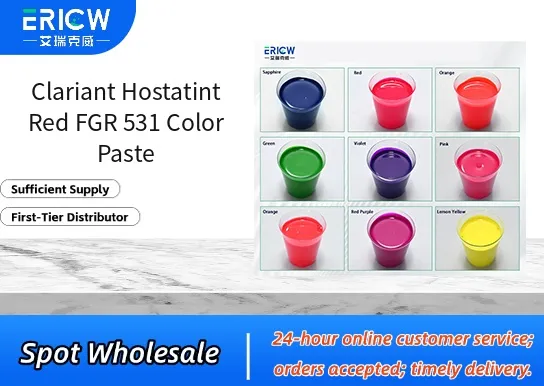
High chroma, brilliant red shade with excellent lightfastness for demanding applications.
Optimized rheology for easy dispersion and uniform color distribution in aqueous systems.
Low volatile organic compound (VOC) content, supporting sustainable formulation requirements.
Good compatibility with common water-based resins including acrylics, vinyl acetates, and polyurethane dispersions.
Stable performance across a broad pH range (pH 6–9), ensuring robustness during processing and storage.
Architectural and industrial waterborne paints and coatings.
Water-based wood stains and varnishes.
Printing inks for packaging and labeling (non-food-contact applications).
Leather finishing systems requiring vivid, durable red tones.
Plastic color concentrates for rigid PVC and ABS compounds.
| Chemical Type | Organic pigment dispersion (P.R. 112 based) |
| Product Form | Ready-to-use aqueous color paste |
| Appearance | Homogeneous, viscous red paste |
| Primary Applications | Waterborne coatings, inks, leather finishes, plastic coloration |
| Key Features | High tinting strength, low dusting, non-settling stability |
| Benefits | Reduced formulation time, consistent batch-to-batch color accuracy, minimal filtration needs |
| Storage Conditions | Store at 5–30 °C; protect from freezing and direct sunlight |
| Shelf Life | 12 months from date of manufacture when stored properly |
Q1: What is the primary application field for Hostatint Red FGR 531?
A: Hostatint Red FGR 531 is specifically developed for coloring polyolefin-based packaging materials, including flexible films and rigid containers used in food, pharmaceutical, and consumer goods applications. It is optimized for high-temperature processing such as extrusion and injection molding.
Q2: Is this color paste suitable for food-contact applications?
A: Yes — Hostatint Red FGR 531 is formulated to comply with global regulatory expectations for indirect food contact, including FDA 21 CFR and relevant EU frameworks. Final compliance depends on the full formulation, processing conditions, and end-use requirements, so validation testing is recommended for each specific application.
Q3: How should this paste be incorporated into polyolefin compounds?
A: The paste is designed for direct addition during compounding — typically via side-stuffer feeder or gravimetric dosing systems. It exhibits excellent dispersion stability and melt compatibility with PP and PE matrices, minimizing agglomeration and streaking under standard processing conditions.
Q4: What are the key handling and storage recommendations?
A: Store in original sealed containers at temperatures between 5 °C and 30 °C, away from direct sunlight and moisture. Avoid freezing. For optimal performance, use within 12 months of receipt. Prior to use, gently stir to ensure homogeneity if sedimentation has occurred during storage.
Contact With Us:
E-mail: wangxingqiang@ericwchem.com
Have a Questions? Call Us:
Add:
Building A1, Jiete Industrial Park, Huangpu District, Guangzhou City, Guangdong Province, China