English
 Español
 tiếng việt
 русский
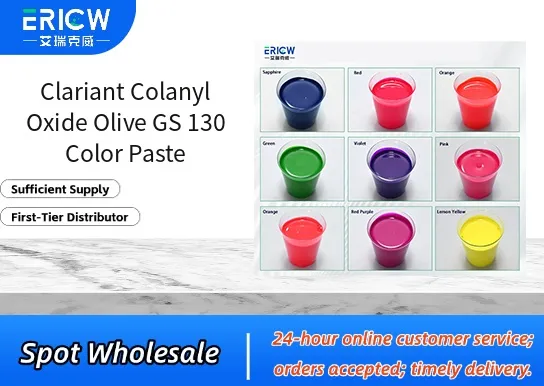
High chroma olive-green shade with excellent batch-to-batch consistency.
Optimized for oxidative curing systems in alkyd and air-drying coatings.
Good lightfastness and weather resistance suitable for exterior applications.
Low volatile organic compound (VOC) content, supporting sustainable formulation goals.
Easy dispersion and excellent compatibility with common resin systems including polyester and acrylic binders.
Architectural coatings for façades and metal cladding.
Industrial maintenance coatings for infrastructure and equipment.
Marine and protective coatings requiring corrosion-resistant colorants.
Wood finishes where natural olive-toned aesthetics and durability are required.
General-purpose air-drying alkyd enamels for OEM and refinish markets.
| Chemical Type | Organic-inorganic hybrid oxide pigment dispersion |
| Product Form | Non-aqueous liquid color paste |
| Appearance | Olive-green viscous paste, homogeneous without sedimentation |
| Primary Applications | Oxidative drying coatings, alkyd-based systems, air-dry industrial finishes |
| Key Features | High opacity, good tinting strength, thermal stability up to 180°C |
| Benefits | Reduced formulation complexity, improved color development, enhanced storage stability |
| VOC Content | <50 g/L (as per ISO 11890-2) |
| Recommended Carrier | Alkyd resin solution or aromatic hydrocarbon solvent blend |
Q1: What is the primary application of Colanyl Oxide Olive GS 130 Color Paste?
A: Colanyl Oxide Olive GS 130 is a highly concentrated, solvent-free color paste specifically developed for coloring polyolefin compounds—particularly PP and PE—used in injection molding, blow molding, and extrusion applications where consistent olive-green shade and excellent thermal stability are required.
Q2: Is this color paste compatible with food-contact polyolefin applications?
A: Colanyl Oxide Olive GS 130 is formulated without heavy metals or restricted aromatic amines and is suitable for food-contact applications where regulatory compliance is supported by appropriate system-level testing and documentation. Final compliance depends on the full formulation, processing conditions, and end-use requirements.
Q3: How should this color paste be incorporated into polyolefin resins?
A: It is typically introduced via gravimetric or volumetric dosing directly into the feed throat of extruders or injection molding machines. Pre-blending with carrier resin is not required, but thorough dispersion during melt processing ensures optimal color uniformity and pigment distribution.
Q4: What are the recommended storage conditions?
A: Store in original sealed containers at temperatures between 5 °C and 30 °C, away from direct sunlight and sources of heat. Avoid freezing, as low temperatures may affect rheology and dispersion performance upon use.
Contact With Us:
E-mail: wangxingqiang@ericwchem.com
Have a Questions? Call Us:
Add:
Building A1, Jiete Industrial Park, Huangpu District, Guangzhou City, Guangdong Province, China