English
 Español
 tiếng việt
 русский
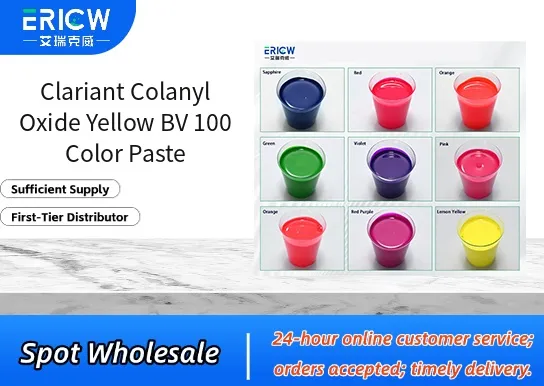
High chroma yellow shade with excellent lightfastness and weather resistance.
Optimized rheology for easy dispersion in water-based and solvent-based systems.
Low volatile organic compound (VOC) content, supporting sustainable formulation requirements.
Consistent batch-to-batch color strength and hue, ensuring reliable production quality.
Compatible with a broad range of binders including acrylics, alkyds, and polyurethanes.
Architectural coatings for interior and exterior wall paints.
Industrial maintenance coatings for metal protection and signage.
Wood coatings including stains, varnishes, and clear finishes.
Plastic coloration for rigid PVC, ABS, and polystyrene applications.
Printing inks for packaging and commercial offset printing.
| Chemical Type | Inorganic pigment dispersion (iron oxide-based) |
| Product Form | Concentrated liquid color paste |
| Appearance | Homogeneous yellow paste, free from grit or lumps |
| Primary Applications | Water-based and solvent-based coatings, inks, and plastics |
| Key Features | High opacity, good tinting strength, thermal stability up to 180°C |
| Benefits | Reduced formulation complexity, improved storage stability, low migration tendency |
| pH Value (25°C) | 7.5–8.5 |
| Storage Stability | ≥12 months in sealed original container at 5–30°C |
Q1: What types of polymer systems is Colanyl Oxide Yellow BV 100 compatible with?
A: Colanyl Oxide Yellow BV 100 is formulated for use in a broad range of thermoplastics, including polyolefins (PP, PE), PS, ABS, and engineering polymers such as PA and PBT. It demonstrates good thermal stability and dispersion behavior during standard melt processing.
Q2: How should this color paste be incorporated into the base polymer?
A: The paste is typically introduced via gravimetric or volumetric dosing directly into the extruder feed throat or upstream of the melting zone. Pre-blending with carrier resin or masterbatch dilution may be used to ensure uniform distribution, especially in high-precision applications.
Q3: Is Colanyl Oxide Yellow BV 100 suitable for food-contact or medical-grade applications?
A: This product is not pre-qualified for regulated food-contact or medical applications. Customers must conduct full regulatory evaluation—including migration testing and compliance verification—based on their specific formulation, processing conditions, and end-use requirements.
Q4: What is the recommended dosage range for achieving target shade intensity?
A: Dosage depends on the base polymer, desired chroma, and processing method, but typical usage generally ranges from 0.1% to 2% by weight. Lower concentrations are often sufficient due to the high tinctorial strength of the oxide yellow pigment system.
Contact With Us:
E-mail: wangxingqiang@ericwchem.com
Have a Questions? Call Us:
Add:
Building A1, Jiete Industrial Park, Huangpu District, Guangzhou City, Guangdong Province, China