English
 Español
 tiếng việt
 русский
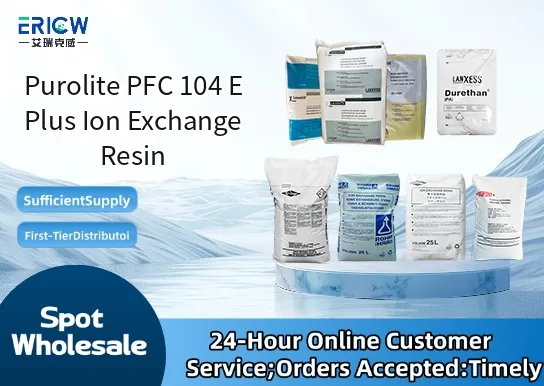
Highly selective for phosphate and arsenate anions in complex water matrices.
Engineered with enhanced chemical stability for extended service life in aggressive oxidizing environments.
Low pressure drop design enables efficient operation in both fixed-bed and packed-column systems.
Consistent spherical bead morphology ensures uniform flow distribution and minimizes channeling.
Regenerable with sodium chloride solution, supporting sustainable and cost-effective cycle operation.
Drinking water treatment for removal of phosphate to control eutrophication.
Groundwater remediation targeting arsenic (As(V)) and other oxyanions.
Industrial process water polishing in semiconductor and pharmaceutical manufacturing.
Pre-treatment for reverse osmosis systems to prevent scaling and membrane fouling.
| Chemical Type | Strong Base Anion Exchange Resin (Type I, Quaternary Ammonium) |
| Product Form | Moist, spherical beads |
| Appearance | Beige to light brown, translucent beads |
| Functional Group | Triethylbenzylammonium |
| Matrix Structure | Macroporous polystyrene-divinylbenzene copolymer |
| Ion Form | Chloride form (Cl⁻) |
| Particle Size Range | 0.3–1.2 mm |
| Moisture Content | 45–55% (as shipped) |
Q1: What is the primary functional group and ionic form of Purolite PFC 104 E Plus?
A: Purolite PFC 104 E Plus is a strong acid cation exchange resin in the sodium (Na⁺) form, featuring sulfonic acid functional groups grafted onto a highly crosslinked polystyrene-divinylbenzene matrix.
Q2: How does PFC 104 E Plus differ from standard gel-type strong acid cation resins?
A: Unlike conventional gel-type resins, PFC 104 E Plus incorporates a macroporous structure with enhanced physical stability and superior resistance to osmotic shock, making it especially suitable for demanding cyclic operations involving frequent regeneration and high flow rates.
Q3: Is this resin suitable for food-grade or pharmaceutical water polishing applications?
A: Yes — PFC 104 E Plus is manufactured and tested in compliance with global regulatory expectations for ion exchange resins used in purified water systems, including those supporting USP <731>, EP 2.2.44, and JP standards for pharmaceutical water treatment.
Q4: What regeneration chemicals are recommended for optimal performance?
A: Sodium chloride (NaCl) brine is the standard regenerant for softening service; for full cation removal in demineralization configurations, hydrochloric acid (HCl) may be used depending on system design and operational requirements.
Contact With Us:
E-mail: wangxingqiang@ericwchem.com
Have a Questions? Call Us:
Add:
Building A1, Jiete Industrial Park, Huangpu District, Guangzhou City, Guangdong Province, China