English
 Español
 tiếng việt
 русский
Excellent elasticity and recovery performance across a wide temperature range (−40 °C to 100 °C).
Good processability via injection molding, extrusion, and overmolding onto PP, ABS, and PS substrates.
Low compression set for durable sealing and gasketing applications.
Halogen-free formulation compliant with RoHS and REACH directives.
Smooth surface finish and high gloss retention after processing.
Automotive interior trim components including door handles and control knobs.
Consumer electronics housings and soft-touch grips for power tools and appliances.
Sealing rings and gaskets for HVAC and fluid handling systems.
Medical device grips and non-critical wearable housing components.
Packaging closures and flexible caps requiring tactile feedback and resealability.
| Chemical Type | Thermoplastic Elastomer (TPE), Styrenic Block Copolymer (SBC)-based |
| Product Form | Pellets |
| Appearance | Translucent amber granules |
| Hardness (Shore A) | 55 ± 3 |
| Melt Flow Rate (200 °C/5 kg) | 28–32 g/10 min |
| Density | 0.90–0.92 g/cm³ |
| Tensile Strength | 12–14 MPa |
| Elongation at Break | 650–720 % |
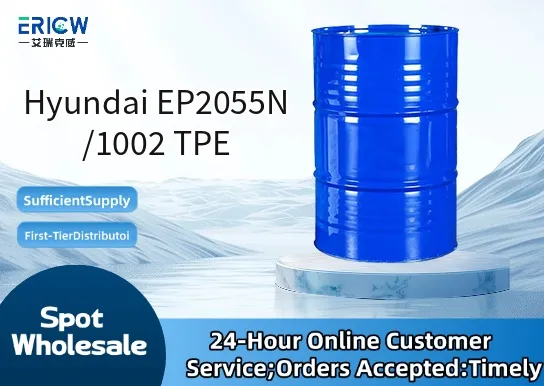
Q1: What is the primary function of Hyundai EP2055N/1002 TPE in polymer formulations?
A: Hyundai EP2055N/1002 TPE is a thermoplastic elastomer designed primarily as a compatibilizer and impact modifier for polyolefin-based blends, especially in PP/EPDM and PP/SEBS systems. It enhances phase adhesion, improves melt processability, and contributes to balanced stiffness-toughness performance.
Q2: Is this grade suitable for applications requiring regulatory compliance for food contact or medical use?
A: Hyundai EP2055N/1002 TPE is not pre-certified for food-contact or medical applications. Customers intending such use must conduct full regulatory evaluation—including extractables testing and compatibility assessment—within their final formulation and processing conditions.
Q3: How does EP2055N/1002 perform under thermal processing conditions like injection molding or extrusion?
A: This TPE exhibits good thermal stability during standard polyolefin processing. It melts cleanly within typical PP processing temperature ranges (180–230 °C) and shows low volatility and minimal plate-out tendency when properly dried and processed with conventional equipment.
Q4: Can EP2055N/1002 be used in recycled or post-consumer polypropylene streams?
A: Yes—it is commonly employed to restore mechanical performance in recycled PP blends where degradation or contamination has reduced impact strength and interfacial cohesion. Dosage typically ranges from 0.1% to 2% by weight, depending on the quality and composition of the recycled feedstock.
Contact With Us:
E-mail: wangxingqiang@ericwchem.com
Have a Questions? Call Us:
Add:
Building A1, Jiete Industrial Park, Huangpu District, Guangzhou City, Guangdong Province, China