English
 Español
 tiếng việt
 русский
Description
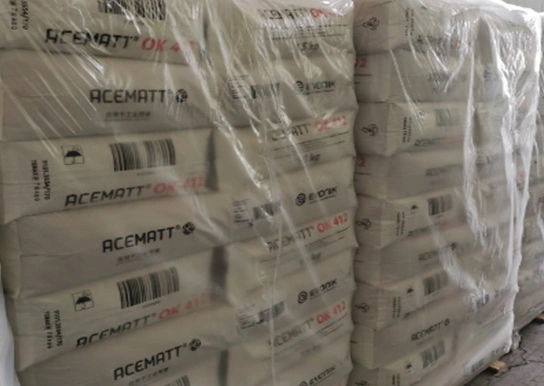
ACEMATT ® OK 412 is a wax-treated, medium particle sized precipitated silica.
By offering very high compatibility, it can be used in a large variety of coatings
Key benefits
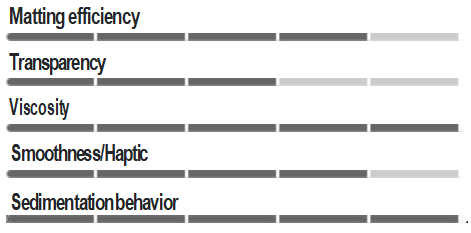
Very low viscosity impact
High surface smoothness
All purpose silica
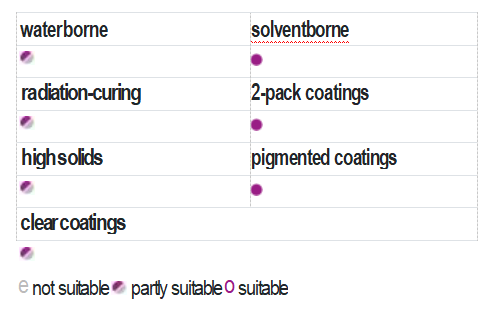
General industrial coatings
Wood coatings
Plastic coatings
Car oem coatings
| carbon content | 5.50% |
| DOA absorption | 250 ml/100g |
| Grindometer value | 27 µm |
| particle size, d50 | 6.3 µm |
| pH-value | 6.3 |
| specific surface area (N2) | 130 m²/g |
Recommended Addition Level of Evonik ACEMATT OK 412 CAS No. 9002-88-4
As supplied calculated on total formulation : 1.5 - 7.0 %
Processing Instructions of Evonik ACEMATT OK 412 CAS No. 9002-88-4
Addition to the coating as supplied or as a predilution is possible.
Handling& Storage of Evonik ACEMATT OK 412 CAS No. 9002-88-4
When stored in an original unopened packaging, the product has a shelf life of 24 months from the date of manufacture.
We recommend to store the product in closed containers under dry conditions and to protect the material from volatile substances.
Q1: What is the primary function of ACEMATT OK 412 in coating and ink formulations?
A: ACEMATT OK 412 is a synthetic amorphous silica designed to provide controlled matting, improved scratch resistance, and enhanced surface texture without significantly compromising transparency or gloss uniformity in solvent-based and radiation-curable systems.
Q2: Is ACEMATT OK 412 suitable for UV-curable coatings?
A: Yes — it is widely used in UV-curable wood, plastic, and metal coatings due to its good dispersibility, low impact on cure speed, and ability to maintain clarity in thin-film applications.
Q3: How should ACEMATT OK 412 be incorporated into a formulation?
A: It is typically added during the pigment grinding stage using high-shear dispersion equipment. Pre-wetting with compatible solvents or resins is recommended to ensure full deagglomeration and stable suspension.
Q4: Does ACEMATT OK 412 affect viscosity or flow behavior?
A: Yes — like most fumed and precipitated silicas, it imparts thixotropic character and can increase low-shear viscosity. The extent depends on loading level, dispersion quality, and resin/solvent polarity.
Contact With Us:
E-mail: wangxingqiang@ericwchem.com
Have a Questions? Call Us:
Add:
Building A1, Jiete Industrial Park, Huangpu District, Guangzhou City, Guangdong Province, China