English
 Español
 tiếng việt
 русский
Excellent abrasion resistance for extended service life in demanding mechanical environments.
High elasticity and recovery performance with consistent tensile resilience across temperature ranges.
Good processability via extrusion, injection molding, and blow molding without requiring plasticizers.
Outstanding oil, grease, and hydrocarbon resistance compared to conventional thermoplastic elastomers.
Halogen-free formulation supporting compliance with RoHS and REACH regulatory requirements.
Automotive interior trim components including instrument panel skins and door inserts.
Industrial hoses and pneumatic tubing requiring flexibility, pressure resistance, and chemical durability.
Consumer electronics protective casings and soft-touch overmolded grips.
Medical device tubing and non-implantable wearable components meeting ISO 10993 biocompatibility screening.
Sports equipment parts such as grip layers, gaskets, and dynamic cushioning elements.
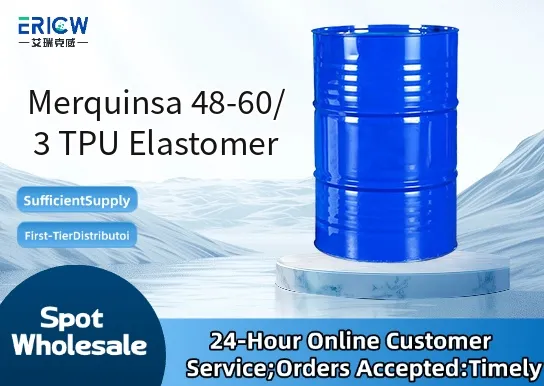
| Chemical Type | Aliphatic polyester-based thermoplastic polyurethane (TPU) |
| Product Form | Pellets |
| Appearance | Off-white to light beige granules, free-flowing, uniform size |
| Shore A Hardness | 48–60 |
| Density (g/cm³) | 1.18–1.22 |
| Melt Flow Index (230°C/5 kg) | 3–5 g/10 min |
| Primary Applications | Extruded profiles, molded parts, overmolding substrates |
| Key Features | Abrasion resistance, elasticity, process stability, halogen-free |
Q1: What is the primary application domain for Merquinsa 48-60/3?
A: Merquinsa 48-60/3 is a thermoplastic polyurethane elastomer specifically engineered for high-performance extrusion and injection molding applications, commonly used in flexible tubing, technical profiles, and soft-touch overmolding where resilience, abrasion resistance, and consistent melt processability are required.
Q2: Is this grade suitable for food-contact or medical-grade processing?
A: Merquinsa 48-60/3 is formulated without plasticizers or heavy-metal catalysts and is compatible with common food-contact and medical-grade compounding practices; however, final regulatory compliance depends on the full formulation, processing conditions, and end-use validation by the compounder or device manufacturer.
Q3: How does Merquinsa 48-60/3 differ from standard aromatic TPU grades?
A: Unlike conventional aromatic TPUs, Merquinsa 48-60/3 features an aliphatic backbone, delivering superior UV stability and long-term color retention—making it especially suitable for outdoor applications or transparent/colored parts where yellowing must be minimized.
Q4: What drying and processing conditions are recommended?
A: Prior to processing, Merquinsa 48-60/3 should be dried at 70–80 °C for 2–4 hours to achieve a moisture content below 0.05%. Typical melt processing temperatures range between 170 °C and 210 °C, depending on equipment and part geometry.
Contact With Us:
E-mail: wangxingqiang@ericwchem.com
Have a Questions? Call Us:
Add:
Building A1, Jiete Industrial Park, Huangpu District, Guangzhou City, Guangdong Province, China