English
 Español
 tiếng việt
 русский
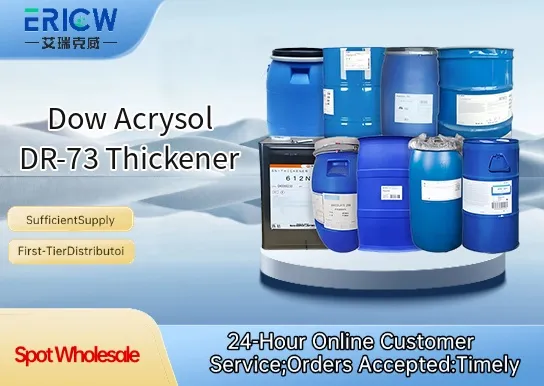
High-shear rheology modifier delivering excellent sag resistance in vertical applications.
Compatible with a broad range of anionic, nonionic, and cationic surfactants and co-binders.
Enables low-VOC and zero-VOC formulations without compromising viscosity stability.
Provides rapid viscosity development upon addition, supporting efficient high-speed manufacturing.
Offers outstanding freeze-thaw stability in waterborne architectural and industrial coatings.
Architectural interior and exterior latex paints.
Industrial maintenance coatings for metal and concrete substrates.
Waterborne wood stains and clear finishes.
Acrylic-based mastics and sealants.
Low-dust dry-mix mortars and tile adhesives (when pre-dispersed).
| Chemical Type | Hydrophobically modified ethoxylated urethane (HEUR) associative thickener |
| Product Form | Clear to slightly hazy aqueous liquid |
| Appearance | Light amber to pale yellow liquid |
| pH (1% solution) | 6.5–8.0 |
| Active Content | 25–27 wt% |
| Viscosity (25°C, Brookfield RVT, Spindle #3, 20 rpm) | 500–2,500 cP |
| Solubility | Water-soluble; miscible with common co-solvents (e.g., propylene glycol, DPG) |
| Primary Applications | Waterborne coatings, construction chemicals, and specialty dispersions |
Q1: What type of rheology does Acrysol DR-73 provide in waterborne formulations?
A: Acrysol DR-73 is an associative thickener that delivers pronounced pseudoplastic (shear-thinning) behavior, enhancing sag resistance while maintaining good flow and leveling during application.
Q2: Is Acrysol DR-73 compatible with high-shear processes and common surfactants used in architectural coatings?
A: Yes — DR-73 exhibits robust compatibility with anionic and nonionic surfactants, as well as stability under moderate to high shear conditions typical of pigment dispersion and let-down stages.
Q3: How should Acrysol DR-73 be incorporated into a formulation for optimal performance?
A: It is recommended to pre-dilute DR-73 with water or a water-miscible solvent before addition, and incorporate it during the post-addition stage—after dispersants and pigments—to avoid interference with stabilization and ensure uniform thickening.
Q4: Does Acrysol DR-73 offer resistance to microbial degradation?
A: DR-73 itself is not inherently antimicrobial, but its polymeric structure provides greater inherent stability against enzymatic breakdown compared to some natural or cellulose-based thickeners; however, inclusion of a suitable preservative system remains essential in aqueous formulations.
Q5: Can Acrysol DR-73 be used in low-VOC or zero-VOC coating systems?
A: Yes — DR-73 is a water-based, APEO-free associative thickener formulated to support modern low-VOC and zero-VOC architectural and industrial coating systems without compromising rheological control or film integrity.
Contact With Us:
E-mail: wangxingqiang@ericwchem.com
Have a Questions? Call Us:
Add:
Building A1, Jiete Industrial Park, Huangpu District, Guangzhou City, Guangdong Province, China