English
 Español
 tiếng việt
 русский
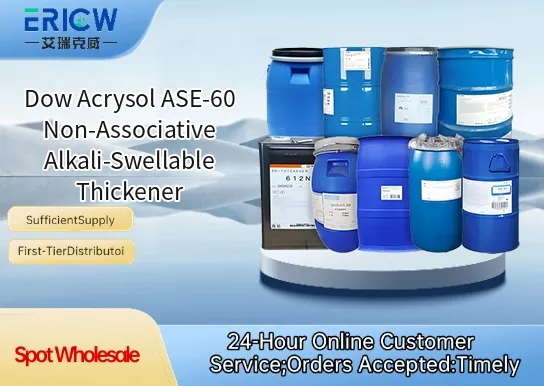
Delivers high-shear viscosity and excellent flow/leveling control in waterborne coatings.
Provides outstanding sag resistance without compromising brushability or rollability.
Offers excellent compatibility with a broad range of latex polymers, pigments, and additives.
Enables stable viscosity build upon pH adjustment (typically pH ≥ 8.5) with minimal sensitivity to electrolytes.
Delivers low foaming characteristics and good spatter resistance in architectural and industrial formulations.
Interior and exterior architectural flat and low-sheen paints.
Textured coatings and decorative plasters.
Waterborne primers and sealers.
Industrial maintenance coatings for metal and concrete substrates.
| Chemical Type | Acrylic acid-based copolymer, non-associative, alkali-swellable |
| Product Form | Aqueous dispersion |
| Appearance | Opaque white liquid |
| pH (as received) | 2.5 – 3.5 |
| Active Content (wt %) | 60.0 ± 1.0% |
| Viscosity (Brookfield RVT, #2 spindle, 20 rpm, 25°C) | 500 – 2,500 cP |
| Specific Gravity (25°C) | 1.04 – 1.07 |
| Recommended Use pH Range | 8.5 – 10.5 |
Q1: How does ASE-60 differ from associative thickeners like HASE or HEUR?
A: ASE-60 is a non-associative, alkali-swellable acrylic polymer that thickens primarily through charge repulsion and chain expansion in alkaline conditions. Unlike associative thickeners (e.g., HASE or HEUR), it does not rely on hydrophobic interactions or micelle formation, resulting in lower sensitivity to surfactants, solvents, and shear history — making it especially robust in high-surfactant architectural coatings and industrial cleaners.
Q2: What pH range is required for optimal viscosity development with ASE-60?
A: ASE-60 requires alkaline activation to fully ionize its carboxylic acid groups and achieve target viscosity. Effective swelling typically begins above pH 7.5 and is most consistent between pH 8.5 and 10.5. Formulators commonly use ammonia, AMP-95, or sodium hydroxide to adjust and stabilize pH during incorporation.
Q3: Can ASE-60 be used in low-VOC or zero-VOC formulations?
A: Yes — ASE-60 is supplied as a water-based latex dispersion containing no added organic solvents or VOC-contributing co-solvents. It supports formulation strategies aligned with low-VOC regulatory frameworks, provided the overall system (including neutralizers and other additives) meets applicable VOC limits.
Q4: How should ASE-60 be incorporated into a waterborne formulation?
A: ASE-60 is generally added late in the let-down stage, after pH adjustment or alongside the neutralizer. Pre-dilution with water or partial neutralization prior to addition helps ensure uniform dispersion and avoids localized over-thickening. High-shear mixing should be minimized post-addition to preserve rheological performance.
Q5: Is ASE-60 compatible with biocides commonly used in architectural paints?
A: ASE-60 demonstrates good compatibility with standard isothiazolinone and benzisothiazolinone-based biocides when used at typical in-can preservation levels. As with any polymer system, compatibility testing under actual formulation conditions — including dosage, pH, and storage time — is recommended to confirm long-term stability and efficacy.
Contact With Us:
E-mail: wangxingqiang@ericwchem.com
Have a Questions? Call Us:
Add:
Building A1, Jiete Industrial Park, Huangpu District, Guangzhou City, Guangdong Province, China