English
 Español
 tiếng việt
 русский
High thermal stability suitable for processing temperatures up to 280°C.
Excellent lightfastness (ISO 105-B02: Grade 7–8) and weather resistance.
Good dispersibility in both polar and non-polar polymer matrices.
Low migration tendency in PVC, polyolefins, and engineering plastics.
Compliant with major global regulatory frameworks including REACH and RoHS.
Coloration of rigid and flexible PVC profiles, cables, and flooring.
Masterbatch formulation for polypropylene (PP) and polyethylene (PE) packaging films.
Automotive interior components requiring long-term UV and heat resistance.
Engineering thermoplastics including ABS and polycarbonate for durable consumer goods.
Industrial coatings and coil coatings where color consistency and durability are critical.
| Chemical Type | Organic pigment – perylene derivative |
| Product Form | Fine powder, free-flowing |
| Appearance | Reddish-brown powder |
| Primary Applications | Polymer coloring, industrial coatings, masterbatches |
| Key Features | High tinctorial strength, low dusting, excellent heat stability |
| Benefits | Reduced dosage requirements, consistent batch-to-batch color matching |
| Density (25°C) | 1.45–1.50 g/cm³ |
| Volatile Matter (105°C, 2 h) | ≤0.5 wt% |
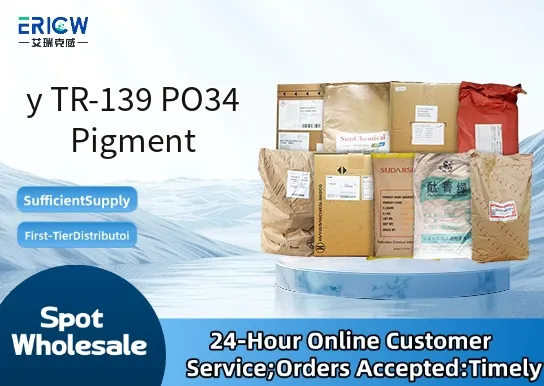
Q1: What is the primary chemical nature of y TR-139 PO34 Pigment?
A: y TR-139 PO34 Pigment is an organic pigment dispersion formulated with a proprietary polymeric stabilizer system, designed to provide excellent compatibility and dispersion stability in polar polymer matrices.
Q2: In which polymer systems is y TR-139 PO34 Pigment most commonly used?
A: It is widely employed in engineering thermoplastics such as polyamide (PA6, PA66), polybutylene terephthalate (PBT), and polycarbonate (PC), particularly where high thermal stability and color consistency during melt processing are required.
Q3: How should y TR-139 PO34 Pigment be incorporated into a polymer formulation?
A: It is typically introduced via masterbatch dilution or direct dry blending prior to extrusion. Pre-drying is recommended for hygroscopic resins to avoid dispersion issues, and gentle mixing avoids destabilizing the pigment’s surface treatment.
Q4: Does y TR-139 PO34 Pigment offer resistance to migration in end-use applications?
A: Yes — its tailored polymeric stabilization and strong pigment–polymer affinity significantly reduce blooming and plate-out tendencies, especially under elevated temperature and humidity conditions typical in automotive and electronic housing applications.
Contact With Us:
E-mail: wangxingqiang@ericwchem.com
Have a Questions? Call Us:
Add:
Building A1, Jiete Industrial Park, Huangpu District, Guangzhou City, Guangdong Province, China