English
 Español
 tiếng việt
 русский
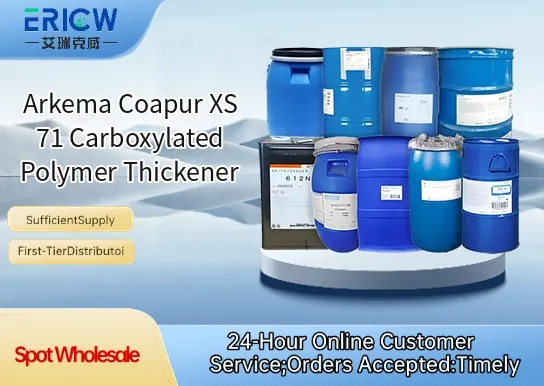
High-efficiency rheology modifier delivering excellent viscosity build and shear-thinning behavior.
Carboxylated acrylic polymer offering superior compatibility with water-based systems and broad pH stability (pH 4–10).
Enables outstanding film formation and improved scrub resistance in architectural coatings.
Low-VOC, APEO-free formulation supporting sustainable product development and regulatory compliance.
Provides excellent pigment dispersion stabilization and long-term storage stability in latex paints.
Interior and exterior architectural flat and low-sheen latex paints.
Textured decorative coatings and stucco finishes.
Water-based industrial maintenance coatings.
Tile grouts and cementitious repair mortars requiring enhanced workability.
Water-based wood stains and clear finishes.
| Chemical Type | Carboxylated acrylic copolymer |
| Product Form | Aqueous dispersion |
| Appearance | Opaque white liquid |
| Solids Content | 28–30 wt% |
| pH (10% aqueous solution) | 3.5–5.0 |
| Viscosity (Brookfield RVT, #2 spindle, 20 rpm, 25°C) | 500–1,500 mPa·s |
| Primary Applications | Water-based architectural and industrial coatings |
| Key Features | Rheology control, pigment stabilization, film integrity enhancement |
Q1: What types of formulations is Coapur XS 71 typically used in?
A: Coapur XS 71 is primarily designed for water-based industrial coatings, architectural paints, adhesives, and construction mortars where rheology control, sag resistance, and brush/roller application performance are critical. It performs well in both acrylic and styrene-acrylic systems.
Q2: How does Coapur XS 71 differ from non-carboxylated associative thickeners?
A: As a carboxylated polymer, Coapur XS 71 offers enhanced compatibility with ionic species and improved tolerance to electrolytes compared to many non-ionic or non-carboxylated associative thickeners. It also provides balanced viscosity build at low shear while maintaining good flow and leveling at high shear.
Q3: What is the recommended addition method for optimal thickening performance?
A: For best results, Coapur XS 71 should be added post-emulsification—typically during the let-down stage—under moderate agitation. Pre-dilution with water or co-solvent may improve dispersion, and pH adjustment to 8.0–9.5 prior to addition helps ensure full activation of the carboxyl groups.
Q4: Is Coapur XS 71 compatible with biocides and other common additives?
A: Yes, Coapur XS 71 demonstrates good compatibility with standard isothiazolinone and formaldehyde-releasing biocides, as well as common defoamers, dispersants, and coalescing agents used in architectural and industrial formulations. Compatibility testing under specific formulation conditions is still recommended.
Contact With Us:
E-mail: wangxingqiang@ericwchem.com
Have a Questions? Call Us:
Add:
Building A1, Jiete Industrial Park, Huangpu District, Guangzhou City, Guangdong Province, China