English
 Español
 tiếng việt
 русский
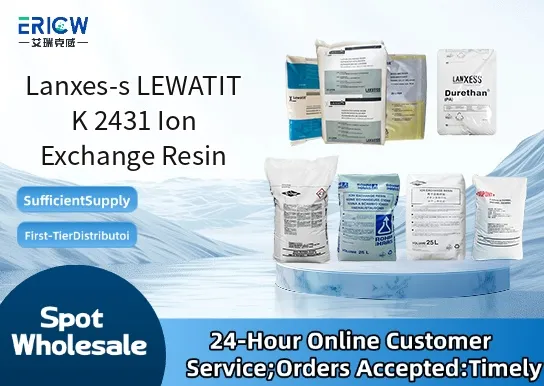
Highly selective for potassium ions (K⁺) in mixed-cation aqueous systems.
Stable polyacrylic matrix ensures excellent mechanical strength and pressure drop performance in fixed-bed operations.
Low sodium leakage and high regeneration efficiency with potassium chloride (KCl) brine.
Optimized bead uniformity and narrow particle size distribution for consistent hydraulic performance.
Chemically resistant to oxidants and compatible with standard industrial regeneration protocols.
Potassium enrichment and sodium removal in food-grade syrup and sweetener processing.
Targeted K⁺ recovery from process effluents in pharmaceutical manufacturing.
Pre-concentration of potassium prior to crystallization in fertilizer production streams.
Ion adjustment in high-purity water circuits requiring low Na⁺ carryover.
Selective softening where calcium/magnesium removal must preserve potassium content.
| Chemical Type | Polyacrylic acid-based cation exchanger, potassium-selective |
| Product Form | Moist, spherical beads |
| Appearance | Opaque white to off-white beads |
| Functional Group | Carboxylic acid (–COOH) |
| Ionic Form | Potassium (K⁺) form as supplied |
| Particle Size Range | 0.3–1.2 mm |
| Moisture Content | Approx. 48–52% (w/w) |
| Maximum Operating Temperature | 100 °C |
Q1: What is the primary functional group and ionic form of LEWATIT K 2431?
A: LEWATIT K 2431 is a strongly basic anion exchange resin in the chloride form, featuring quaternary ammonium functional groups grafted onto a styrene-divinylbenzene matrix.
Q2: Is LEWATIT K 2431 suitable for use in pharmaceutical or food-grade water purification systems?
A: Yes — it is widely applied in high-purity water production for pharmaceutical, biotech, and food & beverage applications, provided it is properly regenerated and validated according to system-specific quality requirements and regulatory expectations for ion exchange resins.
Q3: How does LEWATIT K 2431 differ from standard gel-type strong base anion resins in terms of selectivity and kinetics?
A: As a macroporous resin, K 2431 offers enhanced kinetic performance and improved resistance to organic fouling compared to conventional gel-type resins, particularly in waters containing natural organic matter or low-molecular-weight organics.
Q4: What regeneration chemicals are typically used with this resin?
A: Sodium hydroxide (NaOH) is the standard regenerant for restoring the hydroxide or chloride form; concentration and contact time should be optimized based on service cycle, feedwater composition, and desired effluent quality.
Contact With Us:
E-mail: wangxingqiang@ericwchem.com
Have a Questions? Call Us:
Add:
Building A1, Jiete Industrial Park, Huangpu District, Guangzhou City, Guangdong Province, China