English
 Español
 tiếng việt
 русский
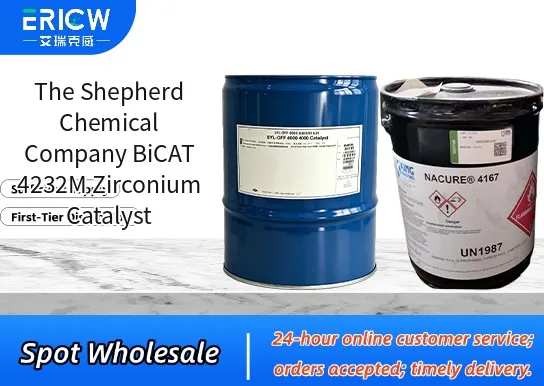
Highly selective zirconium-based catalyst for controlled polycondensation reactions.
Excellent thermal stability enabling consistent performance in high-temperature processing.
Low volatility and minimal residue formation during cure, supporting cleaner end-product profiles.
Compatible with a broad range of polyester, polyether, and silicone resin systems.
Non-toxic alternative to traditional tin or lead catalysts, meeting evolving regulatory requirements.
Polyester resin curing for composites and gel coats.
Condensation-cure silicone elastomers and RTV sealants.
Alkyd resin modification in high-performance coatings.
Crosslinking of hydroxyl-functional acrylics and polyurethanes.
Adhesive and encapsulant formulations requiring low-color, low-odor catalysts.
| Chemical Type | Zirconium chelate complex |
| Product Form | Liquid solution |
| Appearance | Clear, amber-colored liquid |
| Primary Applications | Polyester, silicone, and alkyd resin catalysis |
| Key Features | Low metal content, hydrolytically stable, non-corrosive |
| Benefits | Improved shelf life, reduced side reactions, enhanced clarity in cured resins |
| Solvent Base | Propylene glycol monomethyl ether (PGME) |
| Storage Recommendation | Store in original container at 15–25°C, protect from moisture |
Q1: What is the primary function of BiCAT 4232M in polyurethane systems?
A: BiCAT 4232M is a zirconium-based catalyst designed to promote selective urethane bond formation while minimizing side reactions such as trimerization or hydrolysis—making it especially valuable in moisture-sensitive or high-performance flexible and rigid foam formulations.
Q2: How does BiCAT 4232M compare to traditional tin catalysts like dibutyltin dilaurate (DBTDL)?
A: Unlike organotin catalysts, BiCAT 4232M offers reduced toxicity concerns and improved regulatory acceptance in many global markets. It provides comparable gelling activity with enhanced latency and better compatibility in systems requiring extended cream time or controlled rise profiles.
Q3: Is BiCAT 4232M compatible with common polyol types and isocyanates used in industrial PU applications?
A: Yes—BiCAT 4232M demonstrates broad compatibility with polyester and polyether polyols, as well as aromatic and aliphatic isocyanates. It remains stable in typical storage conditions and shows minimal reactivity with water, supporting consistent performance across diverse formulation platforms.
Q4: What is the recommended handling and storage guidance for BiCAT 4232M?
A: Store in tightly sealed containers under dry, cool conditions away from direct sunlight and moisture sources. Avoid prolonged exposure to ambient humidity during handling, as zirconium complexes may undergo gradual hydrolytic degradation over time if improperly stored.
Q5: Can BiCAT 4232M be used in combination with other catalysts?
A: Yes—BiCAT 4232M is frequently used synergistically with amine catalysts (e.g., DABCO variants) or other metal-based accelerators to fine-tune reactivity balance between gelling and blowing reactions, particularly in complex molded or integral skin foam systems.
Contact With Us:
E-mail: wangxingqiang@ericwchem.com
Have a Questions? Call Us:
Add:
Building A1, Jiete Industrial Park, Huangpu District, Guangzhou City, Guangdong Province, China