English
 Español
 tiếng việt
 русский
Enhanced low-temperature activity for improved reforming efficiency under mild operating conditions.
Superior resistance to sulfur and nitrogen compounds, ensuring stable performance in challenging feedstocks.
Optimized metal dispersion and acid site distribution for balanced cracking, isomerization, and aromatization reactions.
Extended catalyst cycle life with reduced deactivation rates, lowering operational downtime and regeneration frequency.
Designed for compatibility with modern continuous catalyst regeneration (CCR) platforms.
Continuous catalytic reforming (CCR) units processing naphtha feedstocks.
High-severity reforming operations targeting premium high-octane gasoline blendstock (reformate).
Refineries upgrading legacy reformers seeking improved yield structure and hydrogen production.
Integrated refineries requiring robust catalyst performance with variable feed quality and seasonal fluctuations.
Greenfield CCR projects where catalyst reliability and long-term stability are critical design criteria.
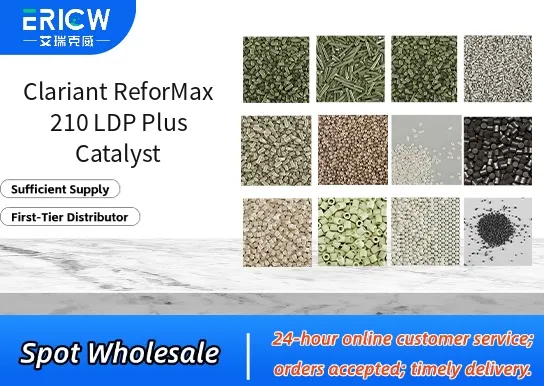
| Chemical Type | Platinum–rhenium–alumina bifunctional reforming catalyst |
| Product Form | Extrudates (cylindrical pellets) |
| Appearance | Gray to dark gray solid granules |
| Primary Applications | Catalytic reforming of straight-run naphtha |
| Key Features | Low-dehydrogenation-pressure (LDP) optimized formulation |
| Benefits | Higher liquid yield, improved C5+ selectivity, enhanced hydrogen production |
| Recommended Regeneration | Continuous catalyst regeneration (CCR) compatible |
| Storage Requirement | Store in dry, inert atmosphere; protect from moisture and air exposure |
Q1: What is the primary function of ReforMax 210 LDP Plus in polyolefin processing?
A: ReforMax 210 LDP Plus is a highly efficient peroxide-based catalyst designed to promote controlled rheology modification—specifically, chain scission—of polypropylene and other polyolefins during extrusion or compounding. It enables consistent melt flow enhancement while supporting good mechanical property retention in final applications.
Q2: How does ReforMax 210 LDP Plus differ from standard low-dose peroxide catalysts?
A: ReforMax 210 LDP Plus features an optimized carrier system and stabilized peroxide formulation that delivers improved thermal latency and more predictable decomposition kinetics. This allows for better process window control, reduced odor generation, and enhanced compatibility with common polyolefin stabilizer packages compared to conventional low-dose peroxides.
Q3: Is ReforMax 210 LDP Plus suitable for food-contact or medical-grade polypropylene applications?
A: ReforMax 210 LDP Plus is formulated for use in high-purity polyolefin systems and has been evaluated for compliance with relevant global regulatory expectations for indirect food contact. Final regulatory approval depends on the complete formulation, processing conditions, and end-use requirements—users should conduct appropriate migration and safety assessments as part of their qualification process.
Q4: What are typical handling and storage recommendations?
A: Store in original sealed containers at temperatures below 25 °C in a dry, well-ventilated area away from direct sunlight, heat sources, and incompatible materials such as strong oxidizers or reducing agents. Avoid prolonged exposure to ambient humidity, and always follow Clariant’s Safety Data Sheet for safe handling procedures and personal protective equipment guidance.
Contact With Us:
E-mail: wangxingqiang@ericwchem.com
Have a Questions? Call Us:
Add:
Building A1, Jiete Industrial Park, Huangpu District, Guangzhou City, Guangdong Province, China